How Long Does It Take to Read a Book? Pages-per-Hour Maths
A 300-page novel takes most adults somewhere between 6 and 10 hours. Here is the simple maths behind that, a table by page count and reading speed, how to measure your own pace in 10 minutes, and how to turn a reading goal into a daily timer.
By Om Vaghani, editor at ClockAura (ConnectGo Infoware). Published 3 November 2026.
"How long will this book take me?" sounds like a question with no answer. Some people finish a novel in a weekend, others take three months. But the maths is actually simple, and once you know your own reading pace you can predict it quite closely.
This guide walks through the numbers: how many words are on a typical page, how fast people usually read, a table you can look up any book in, and how to measure your own speed with a timer in about ten minutes.
The basic formula
Reading time comes down to three numbers:
Reading time (minutes) = (pages x words per page) / words per minute
Or, if you already know how many pages you read in an hour:
Reading time (hours) = pages / pages per hour
That is all there is to it. The tricky part is that both "words per page" and "words per minute" vary a lot, so let's look at sensible values for each.
How many words are on a page?
It depends on the book's format, font and layout. As a rough guide:
| Book type | Typical words per page |
|---|---|
| Large-print or children's chapter book | 150-200 |
| Mass-market paperback novel | 250-300 |
| Standard trade paperback or hardback | 300-350 |
| Dense non-fiction or textbook | 400-500 |
| Academic paper (two-column) | 600-800 |
If you want a better number for one specific book, count the words in three full lines, average them, and multiply by the number of lines on a full page. For example, 11 words per line x 32 lines = about 350 words per page.
E-readers change "pages" depending on your font size, which is why many show a percentage or "time left in book" instead. For e-books, it is often easier to use the total word count if the store lists it.
How fast do people read?
Reading speed varies with the person, the material and the reason for reading. A 2019 review of 190 studies by psychologist Marc Brysbaert put the average adult silent reading rate in English at about 238 words per minute. Most adults fall roughly between 200 and 300 words per minute. Reading slows down a lot for:
- Technical or unfamiliar material
- Reading to learn or take notes
- A second language
- Tiredness, noise or distractions
So the same person might read a thriller at 280 words per minute and a statistics textbook at 100. Both are normal.
Converting to pages per hour (assuming 300 words per page):
| Reading speed (wpm) | Pages per hour (300 words/page) |
|---|---|
| 150 | 30 |
| 200 | 40 |
| 250 | 50 |
| 300 | 60 |
| 400 | 80 |
The calculation: words per minute x 60 / words per page. At 250 wpm, that is 250 x 60 / 300 = 50 pages per hour.
The lookup table
Here is a table for books of different lengths at different speeds, assuming about 300 words per page. Times are rounded.
| Pages | 150 wpm (30 p/h) | 200 wpm (40 p/h) | 250 wpm (50 p/h) | 300 wpm (60 p/h) |
|---|---|---|---|---|
| 100 | 3 h 20 min | 2 h 30 min | 2 h | 1 h 40 min |
| 200 | 6 h 40 min | 5 h | 4 h | 3 h 20 min |
| 300 | 10 h | 7 h 30 min | 6 h | 5 h |
| 400 | 13 h 20 min | 10 h | 8 h | 6 h 40 min |
| 500 | 16 h 40 min | 12 h 30 min | 10 h | 8 h 20 min |
| 800 | 26 h 40 min | 20 h | 16 h | 13 h 20 min |
So a typical 300-page novel is about 5 to 10 hours of reading for most adults. A long fantasy novel of 800 pages is closer to 15 to 25 hours.
If you are adding up reading sessions of different lengths, a time duration calculator saves you doing the minutes-to-hours carrying in your head.
Measure your own speed in 10 minutes
Tables are fine, but your own number is better. Here is a quick test:
- Pick a book you would normally read, at the place you would normally read it.
- Mark your starting point.
- Set a 10-minute timer and read normally. Don't speed up because it is a test.
- When it ends, count the pages you read (use half or quarter pages for the last one).
- Multiply by 6 to get pages per hour.
For example, you read 8.5 pages in 10 minutes. That is 8.5 x 6 = 51 pages per hour.
To get words per minute, multiply pages by words per page and divide by 10. With 300 words per page: 8.5 x 300 / 10 = 255 wpm.
Do this two or three times on different days and average them. Your pace on a tired evening will be slower than on a Sunday morning, and the average is what you will actually get over a whole book.
Worked example: finishing a book by a deadline
Say your book club meets in 12 days and the book is 360 pages. You measured yourself at 45 pages per hour.
- Total reading time: 360 / 45 = 8 hours
- Spread over 12 days: 8 / 12 = 0.67 hours, or 40 minutes a day
Add a little buffer for days you miss. Planning 45 minutes a day over 11 days leaves you a spare day and still gets you there.
A second example: a student needs to read a 220-page set text for English in two weeks, reading slowly to take notes at about 25 pages per hour.
- Total: 220 / 25 = 8.8 hours, about 8 hours 50 minutes
- Over 14 days: about 38 minutes a day
- Realistically, with two days off a week: 10 reading days, about 53 minutes each
In this second case, splitting the time into two sessions of about 25 minutes each is easier to fit around school than one long sitting.
How many books can you read in a year?
This is the same maths, run the other way. If you read for a set time each day:
| Daily reading | Hours per year | 300-page books per year at 50 p/h |
|---|---|---|
| 10 min | about 61 | about 10 |
| 20 min | about 122 | about 20 |
| 30 min | about 183 | about 30 |
| 60 min | 365 | about 60 |
Twenty minutes a day, which is roughly one commute or the time before bed, adds up to around 20 average-length novels a year. That is a lot more than most people expect from such a small daily habit.
Turning it into a daily habit with a timer
Reading goals measured in books ("read 24 books this year") are easy to fall behind on, because one hard book can stall you for a month. Goals measured in time are easier to keep: "read for 20 minutes a day" is the same every day, whatever book you are on.
A timer makes this concrete. Set a 15, 20 or 30-minute timer when you sit down to read, and stop when it ends unless you really want to keep going. A fixed end point makes starting easier, especially on days you don't feel like reading.
Some practical tips:
- Same time, same place. After dinner, on the train, before bed. Attach reading to something you already do.
- Phone in another room. Even a face-down phone pulls attention. A separate timer screen or kitchen timer avoids the temptation.
- Stop in the middle of something interesting. Ending a session mid-chapter makes you keen to pick the book up tomorrow.
- Track minutes, not just books. A simple log of minutes per day shows real progress even during a slow, heavy book.
Common mistakes
- Using your best-day speed. Plan with your average pace, not the pace from one good Sunday morning.
- Assuming all pages are equal. A 400-word textbook page takes a third longer than a 300-word novel page at the same speed.
- Ignoring missed days. A plan that needs every single day has no room for real life. Build in one or two spare days.
- Timing with your phone in your hand. Notifications break the session; use a separate screen or put the phone away.
FAQ
How long does it take to read 100 pages?
For an average adult reading fiction at around 250 words per minute, with about 300 words per page, roughly 2 hours. Slower readers or denser books might take 3 to 4 hours.
How long does it take to read a 300-page book?
Most adults need about 5 to 10 hours. At 50 pages an hour, it is about 6 hours, which is 30 minutes a day for 12 days.
How many pages can I read in an hour?
For typical fiction, most people read 30 to 60 pages an hour. Measure your own with a 10-minute timed read and multiply the pages by 6.
Why do I read slower in some books?
Dense writing, unfamiliar words, small print, and reading to learn all slow you down. That is normal. Use your pace for that type of book, not your fastest pace, when you plan.
How do I work out reading time for an e-book?
Use the word count if it is listed, and divide by your words per minute. Many e-readers also estimate "time left in book" after you have read a few chapters, based on your own pace.
Try it with ClockAura
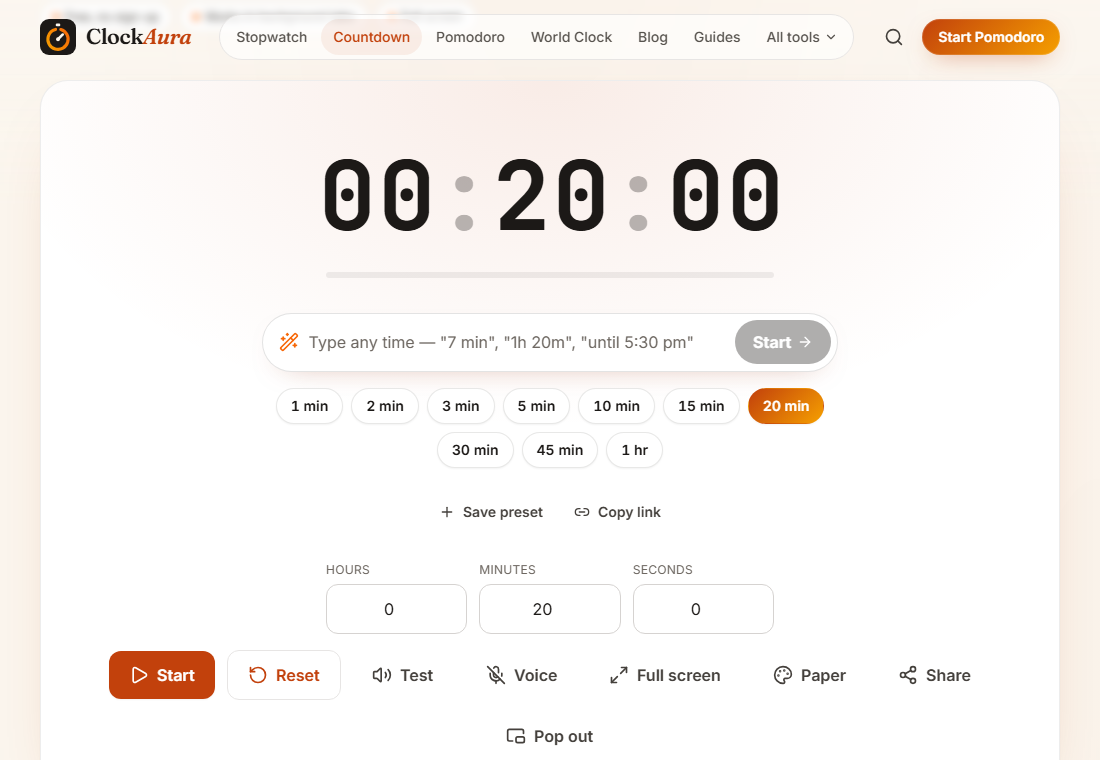
We set the countdown to 20 minutes for the screenshot, the daily habit from the table above that works out at roughly 20 novels a year.
- Open the countdown timer set to 20 minutes.
- Note your page number, then press start.
- Read until the alarm. Count the pages read and multiply by 3 for your pages per hour.
- For the 10-minute speed test, change the time to 10 minutes before starting.
Sources
- British Psychological Society Research Digest, Most comprehensive review to date finds average reading speed is slower than often claimed (summary of Brysbaert, 2019, Journal of Memory and Language).
