Roasting Times for Vegetables at 200 C / 400 F
At 200 C / 400 F, most vegetables roast in 15 to 45 minutes depending on how dense they are and how you cut them. Here is a table by vegetable and cut, the fan oven adjustment, and how to roast a mixed tray so everything finishes together.
By Om Vaghani, editor at ClockAura (ConnectGo Infoware). Published 31 October 2026.
Roasting is the easiest way to make vegetables taste good. A hot oven drives off water, browns the edges and brings out natural sweetness. It needs almost no attention: chop, oil, season, slide the tray in, and come back when the timer goes.
The only tricky part is knowing how long each vegetable needs. Cherry tomatoes are done in 15 minutes. Whole beetroot can take over an hour. Put them on the same tray at the same time and one of them will be wrong.
This guide uses one temperature, 200 C / 400 F, because it suits nearly every vegetable. It gives you times by vegetable and cut, explains the fan oven difference, and shows how to roast a mixed tray so everything finishes at once.
Why 200 C / 400 F works for most vegetables
At this temperature, the outside of the vegetables browns while the inside cooks through. Much lower, and they tend to steam and go soft before they colour. Much higher, and thin pieces can burn before thick ones are tender. 200 C is a reliable middle ground that most home ovens hold well.
Fan vs conventional ovens
The times in this guide are for a conventional oven (no fan, sometimes called top and bottom heat) at 200 C / 400 F.
A fan oven (also called fan-assisted or convection) moves hot air around the food, so it cooks faster and more evenly. The usual adjustment, which oven makers such as Hoover also give, is to lower the temperature by about 20 degrees C, so set a fan oven to around 180 C to get a similar result. Alternatively, keep it at 200 C and start checking 5 to 10 minutes earlier.
Every oven is a little different. Some run hot, some run cool, and many have a hot spot at the back. If your vegetables always brown faster on one side, turn the tray halfway through.
Roasting times at 200 C / 400 F
Times are for vegetables tossed in a little oil, spread in a single layer, in a preheated oven. They are starting points: ovens and pieces vary, so use the timer to know when to check, not when to serve.
| Vegetable | Cut | Approximate time |
|---|---|---|
| Asparagus | whole spears, trimmed | 10-15 min |
| Cherry tomatoes | whole | 15-20 min |
| Green beans | trimmed, whole | 15-20 min |
| Mushrooms | halved or quartered | 15-20 min |
| Courgette / zucchini | 2 cm half-moons or chunks | 20-25 min |
| Bell peppers | 3 cm strips or chunks | 20-25 min |
| Broccoli | medium florets | 20-25 min |
| Cauliflower | medium florets | 25-30 min |
| Red onion | wedges | 25-35 min |
| Brussels sprouts | halved | 25-30 min |
| Aubergine / eggplant | 2.5 cm cubes | 25-30 min |
| Carrots | 2 cm batons or 1.5 cm coins | 25-35 min |
| Parsnips | batons | 30-35 min |
| Sweet potato | 2.5 cm cubes | 25-35 min |
| Butternut squash | 2.5 cm cubes | 30-40 min |
| Potatoes | 3-4 cm chunks | 40-50 min |
| Beetroot | 2.5 cm wedges | 35-45 min |
| Garlic bulb | whole, top sliced off, wrapped in foil | 40-50 min |
The pattern is easy to remember. Watery, tender vegetables like tomatoes, mushrooms, asparagus and courgettes roast quickly. Dense root vegetables like potatoes, beetroot, squash and parsnips take much longer.
The cut matters as much as the vegetable
Two carrots roasted at the same temperature can be 15 minutes apart if one is cut into thin coins and the other is left in thick chunks. A few rules of thumb:
- Cut evenly. Pieces of the same size cook at the same rate.
- Smaller is faster. Thinner pieces soften noticeably sooner, so cut to match the time you have.
- Flat sides brown. Cutting a vegetable to give it a flat side, like halved Brussels sprouts or wedges of onion, gives more surface in contact with the hot tray and better colour.
If you want to roast slow and fast vegetables together, cut the dense ones small and the tender ones large. That narrows the gap.
A worked example: one-tray mixed vegetables
Say you want a tray of roast vegetables ready for 7:00 pm. You have potatoes, carrots, red onion, peppers and courgettes.
Look up each in the table and plan backwards:
| Vegetable | Time needed | Goes in at |
|---|---|---|
| Potatoes, 3 cm chunks | 45 min | 6:15 pm |
| Carrots, batons | 30 min | 6:30 pm |
| Red onion, wedges | 30 min | 6:30 pm |
| Peppers, chunks | 20 min | 6:40 pm |
| Courgettes, chunks | 20 min | 6:40 pm |
So the plan is:
- 6:00 pm - Preheat the oven to 200 C (180 C fan). Chop everything.
- 6:15 pm - Potatoes go in on their own tray, or on one end of a large tray.
- 6:30 pm - Add the carrots and onion, toss everything in the oil on the tray.
- 6:40 pm - Add the peppers and courgettes, toss again.
- 7:00 pm - Everything comes out together.
The simplest way to run this is with two or three short timers rather than one long one. Start a 15-minute timer when the potatoes go in, then a 10-minute timer, then a 20-minute timer. Labelled timers (see below) mean you do not have to remember which alarm is which.
Tossing the tray each time you add something also turns the early vegetables, which helps them brown on more than one side.
Try it with ClockAura
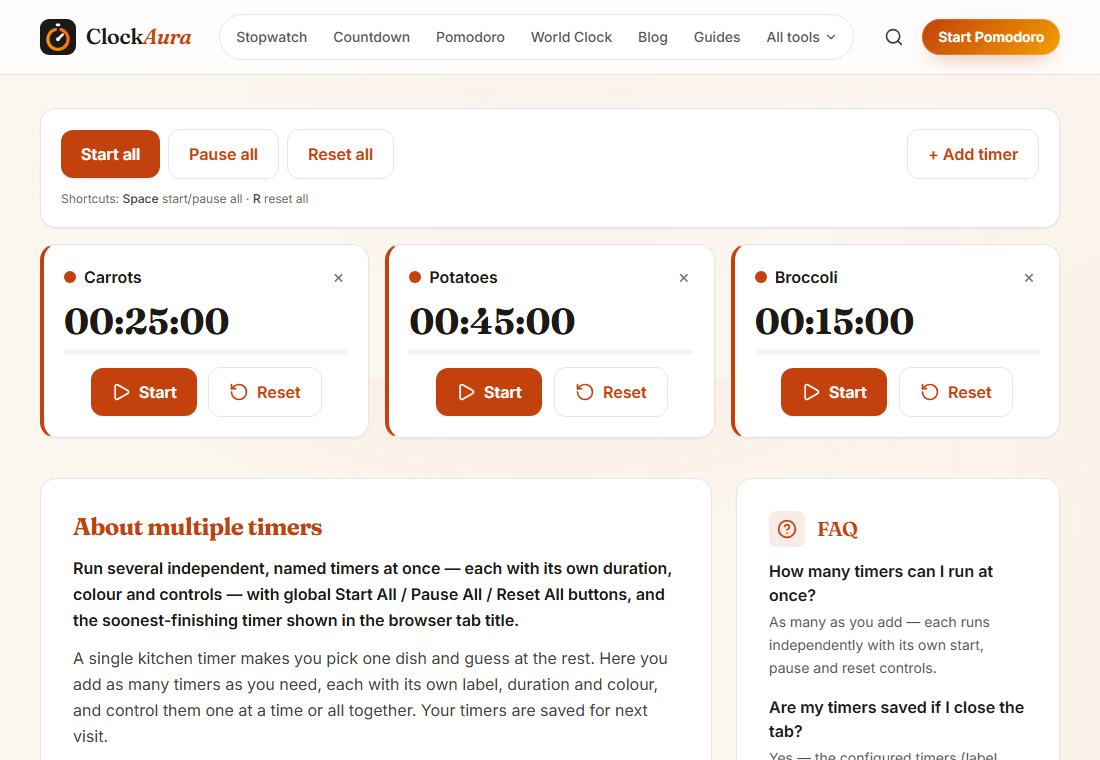
To run the 7:00 pm tray above:
- Open multiple timers and add three timers: "Add carrots + onion" 15 min, "Add peppers + courgettes" 25 min, "Out" 45 min.
- Start all three together when the potatoes go in at 6:15.
- When each alarm rings, add the next vegetables and toss the tray.
- When "Out" rings, test the thickest potato with a knife before serving.
Five habits for better roast vegetables
1. Do not crowd the tray. This is the most common mistake. When pieces touch or pile up, they trap steam and go soft instead of browning. Leave a little space between them, and use two trays if you need to.
2. Dry them first. Washed vegetables carry water into the oven. Pat them dry with a clean towel before oiling.
3. Use enough oil, but not a puddle. About 1 tablespoon of oil per 500 g of vegetables is a good starting point. Toss them in a bowl so every piece is lightly coated.
4. Preheat the tray. For extra crispness on potatoes and root vegetables, put the empty tray in the oven while it heats, then add the oiled vegetables carefully. They start sizzling straight away.
5. Add delicate seasonings at the end. Dried herbs and spices can go on at the start. Fresh soft herbs, garlic that is chopped small, lemon juice and grated cheese burn easily, so add them in the last 5 minutes or after roasting.
Common mistakes
- Crowding one tray. Steam builds up and the vegetables go soft and pale. Use two trays.
- Putting everything in at once. Courgettes at 45 minutes go mushy while potatoes catch up. Stagger them as in the worked example.
- Not preheating. Vegetables sit in a warming oven and steam. Wait until the oven reaches temperature.
- Using fan-oven settings with conventional times. At 200 C fan, start checking 5 to 10 minutes early.
- Adding chopped garlic or fresh herbs at the start. They burn long before the potatoes are done.
How to tell when they are ready
Use the timer to know when to check, then trust your eyes and a knife:
- Colour. You want golden to deep brown edges, not just pale and soft.
- Texture. A knife should slide easily into the thickest piece.
- Shrinkage. Most vegetables shrink a little and look slightly wrinkled when well roasted.
If they are tender but pale, leave them in for 5 more minutes or move the tray to the top shelf. If they are browning fast but still hard inside, lower the heat by 10 to 20 degrees and give them more time.
Safety note
Use oven gloves and take care when opening the oven door, as a rush of hot air and steam comes out. Stand back slightly and let it clear before reaching in. If you preheat a tray with oil in it, add the vegetables slowly and away from you to avoid spitting. Cool leftovers quickly, get them into the fridge promptly, and follow your local food-safety guidance on how many days to keep them, as advice differs by country.
FAQ
Should I cover vegetables with foil when roasting? Usually no. Foil traps steam and stops browning. The exception is a whole garlic bulb or whole beetroot, which benefit from being wrapped so they soften without drying out.
Can I roast frozen vegetables? Yes. Do not thaw them first. Spread them out well, roast at 200 C and expect them to need a little longer. They will be softer than fresh, but still tasty.
Do I need to flip vegetables halfway? It helps for even colour, especially for root vegetables. A quick toss with a spatula is enough.
Why are my roast vegetables soggy? Usually the tray is too crowded, the oven was not fully preheated, or the vegetables were wet. Fix those three things and they will crisp up.
Can I roast vegetables at a lower temperature? Yes, but they will take longer and brown less. At 180 C conventional, add roughly 10 to 15 minutes to the times above.
For more kitchen timings, browse our guides.