How to Calculate Running Pace per Km and per Mile
Pace is just time divided by distance, but minutes and seconds make the arithmetic awkward. Here is the method step by step, how to convert between minutes per km and minutes per mile, how to predict a finish time, and a ready-made table for 5K, 10K, half marathon and marathon.
By Om Vaghani, editor at ClockAura (ConnectGo Infoware). Published 1 November 2026.
Running pace sounds simple until you try to work it out on a sticky phone screen after a run. You know you ran 10 km in 58 minutes and 30 seconds. What is that per kilometre? What is it per mile? If you kept the same pace for a half marathon, when would you finish?
All of these come from one idea:
Pace = time / distance
The only thing that makes it awkward is that time is written in minutes and seconds, which do not behave like ordinary decimals. Once you know how to handle that, every pace question becomes a few lines of arithmetic.
Pace versus speed
Pace and speed describe the same thing from opposite directions.
- Pace is time per distance, for example 6:00 per km (6 minutes for every kilometre).
- Speed is distance per time, for example 10 km/h.
Runners usually talk in pace because it maps directly onto split times and race plans. Treadmills and cycling apps often show speed. Converting between them is easy:
Speed (km/h) = 60 / pace in minutes per km
At 6:00 per km: 60 / 6 = 10 km/h. At 5:00 per km: 60 / 5 = 12 km/h. At 5:30 per km: 60 / 5.5 = about 10.9 km/h.
And the other way round, pace (min/km) = 60 / speed. At 8 km/h: 60 / 8 = 7.5 minutes, which is 7:30 per km.
Step 1: turn the time into one unit
The cleanest method is to convert everything into seconds (or into decimal minutes), do the division, then convert back.
Worked example: 5 km in 27:45
- Convert to seconds: 27 minutes x 60 = 1,620 seconds. Add 45 seconds: 1,620 + 45 = 1,665 seconds.
- Divide by distance: 1,665 / 5 = 333 seconds per km.
- Convert back: 333 / 60 = 5 remainder 33. So the pace is 5:33 per km.
Worked example: 10 km in 58:30
- In decimal minutes, 30 seconds is 30 / 60 = 0.5 minutes, so the time is 58.5 minutes.
- Divide by distance: 58.5 / 10 = 5.85 minutes per km.
- Convert the decimal part back to seconds: 0.85 x 60 = 51 seconds. So the pace is 5:51 per km.
The most common mistake is to read 58:30 as 58.30 minutes. It is not. Thirty seconds is half a minute, so it is 58.5.
Step 2: converting between per km and per mile
One mile is 1.609344 km. Because a mile is longer than a kilometre, your pace per mile is always a bigger number than your pace per km.
Pace per mile = pace per km x 1.609344 Pace per km = pace per mile / 1.609344
Worked example: 6:00 per km to per mile
- 6:00 is 6 minutes.
- 6 x 1.609344 = 9.656 minutes.
- 0.656 x 60 = 39.4 seconds, which rounds to 39.
- Pace is about 9:39 per mile.
Worked example: 5:51 per km to per mile
- 5:51 is 5 + 51/60 = 5.85 minutes.
- 5.85 x 1.609344 = 9.4147 minutes.
- 0.4147 x 60 = 24.9 seconds, which rounds to 25.
- Pace is about 9:25 per mile.
Worked example: 10:00 per mile to per km
- 10 / 1.609344 = 6.2137 minutes.
- 0.2137 x 60 = 12.8 seconds, which rounds to 13.
- Pace is about 6:13 per km.
Step 3: predicting a finish time
To go the other way, from pace to finish time, multiply:
Finish time = pace x distance
The standard race distances are:
- 5K = 5 km
- 10K = 10 km
- Half marathon = 21.0975 km
- Marathon = 42.195 km
Worked example: half marathon at 6:00 per km
- 6 minutes x 21.0975 km = 126.585 minutes.
- 126 minutes is 2 hours and 6 minutes.
- 0.585 x 60 = 35.1 seconds, so about 35 seconds.
- Finish time is about 2:06:35.
Worked example: marathon at 5:30 per km
- 5.5 x 42.195 = 232.0725 minutes.
- 232 minutes is 3 hours (180 minutes) and 52 minutes.
- 0.0725 x 60 = 4.35 seconds, so about 4 seconds.
- Finish time is about 3:52:04.
These are even-pace predictions. Real races rarely go exactly to plan, because of hills, crowds, weather and fatigue, so treat them as targets rather than promises.
Finish-time table
Here are even-pace finish times for common paces. Times are rounded to the nearest second.
| Pace per km | Pace per mile | 5K | 10K | Half marathon | Marathon |
|---|---|---|---|---|---|
| 5:00 | 8:03 | 25:00 | 50:00 | 1:45:29 | 3:30:59 |
| 5:30 | 8:51 | 27:30 | 55:00 | 1:56:02 | 3:52:04 |
| 6:00 | 9:39 | 30:00 | 1:00:00 | 2:06:35 | 4:13:10 |
| 6:30 | 10:28 | 32:30 | 1:05:00 | 2:17:08 | 4:34:16 |
| 7:00 | 11:16 | 35:00 | 1:10:00 | 2:27:41 | 4:55:22 |
You can check any row with the same method. For example, 7:00 per km over a marathon: 7 x 42.195 = 295.365 minutes. 295 minutes is 4 hours 55 minutes, and 0.365 x 60 = 21.9 seconds, which rounds to 22. That gives 4:55:22.
Step 4: working out the pace you need for a goal
Often you start with a goal time and want to know what pace to run.
Worked example: a 10K in under 50 minutes
- 50 minutes / 10 km = 5 minutes per km.
- To finish under 50:00 you need to average a little faster than 5:00 per km.
Worked example: a half marathon in 2 hours
- 2 hours = 120 minutes.
- 120 / 21.0975 = 5.688 minutes per km.
- 0.688 x 60 = 41.3 seconds.
- You need about 5:41 per km, or slightly faster to leave a small margin.
A common practical tip is to plan a few seconds per km faster than the exact number, because GPS watches often measure a race as a little longer than its official distance if you do not run the shortest possible line.
Split times during a run
Knowing your pace also tells you where you should be at each checkpoint. At 5:41 per km in a half marathon:
- 5 km: 5 x 5:41 = 28:25 (5 x 341 seconds = 1,705 seconds = 28 minutes 25 seconds)
- 10 km: 56:50 (3,410 seconds)
- 15 km: 1:25:15 (5,115 seconds)
- 20 km: 1:53:40 (6,820 seconds)
A stopwatch with a lap button lets you record each kilometre as you go.
Common mistakes
Treating seconds as decimals. 5:30 is 5.5 minutes, not 5.3.
Mixing units mid-calculation. Pick km or miles and stay with it until the last step.
Rounding too early. Keep at least three decimal places until the final step, then round to the nearest second.
Forgetting the extra bit of a race. A half marathon is 21.0975 km, not 21 km. Over two hours that small difference is worth about half a minute.
Try it with ClockAura
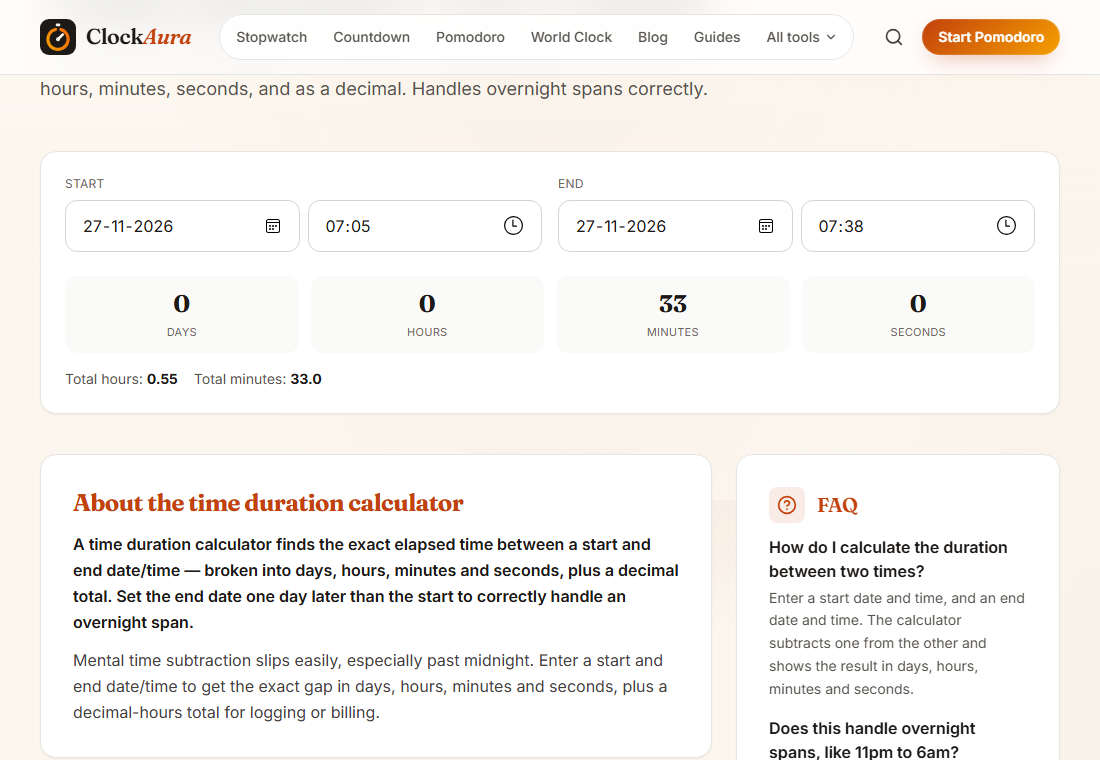
The calculator handles the awkward part: the elapsed time between a start and finish clock time, which you then divide by distance.
- Open the time duration calculator.
- Enter the date, your start time (say 7:05) and your finish time (say 7:38). It shows the duration: 33 minutes.
- Convert to seconds (33 x 60 = 1,980) and divide by your distance, say 5 km: 1,980 / 5 = 396 seconds.
- 396 / 60 = 6 remainder 36, so the pace is 6:36 per km. The time inputs work in whole minutes, so use your watch's time if you need seconds.
FAQ
What is a good running pace for a beginner? There is no single answer. A good beginner pace is one you can hold while still able to talk in short sentences. For many new runners that is somewhere around 6:30 to 8:00 per km, but slower is completely fine.
Why does my watch pace jump around? GPS readings wobble, especially near tall buildings or trees. Average pace over a whole kilometre is more reliable than the live number.
How do I convert km/h on a treadmill to pace? Divide 60 by the speed. At 9 km/h, 60 / 9 = 6.667 minutes, which is 6:40 per km.
Is even pacing the best strategy? For many runners, starting slightly controlled and holding steady works well. Going out much faster than goal pace often leads to a painful slowdown later.
A short safety note: if you are training for a longer race, increase your distance gradually and check with a doctor first if you have any health concerns.