How to Work Out Time Zone Differences Without Mistakes
The safest way to convert between time zones is to go through UTC: subtract the first offset, then add the second. Here is the method step by step, how to handle half-hour zones like India's UTC+5:30, the daylight saving traps that catch people every spring and autumn, and worked examples that cross midnight.
By Om Vaghani, editor at ClockAura (ConnectGo Infoware). Published 27 October 2026.
Time zone mistakes are small and expensive. A client waits on a video call for an hour that you thought started later. A relative gets a birthday call at 4 in the morning. A deadline you thought was "end of Friday" was actually end of Friday somewhere eight hours ahead of you.
Most of these errors come from trying to remember a difference, like "New York is 10 and a half hours behind India", and then forgetting that the difference changes during the year. There is a more reliable way, and it works for any pair of places on Earth.
The one method that always works: go through UTC
Every time zone is defined as an offset from UTC (Coordinated Universal Time). India is UTC+5:30. Japan is UTC+9. New York is UTC-5 in winter and UTC-4 in summer.
To convert a time from place A to place B:
- Convert A's time to UTC by subtracting A's offset.
- Convert UTC to B's time by adding B's offset.
That is it. Subtracting a negative offset means adding, which is the only part that needs a little care. If you want to know how UTC relates to GMT, our guide on GMT vs UTC explains the difference.
Worked example: Tokyo to London in January
It is 18:00 in Tokyo. What time is it in London?
- Tokyo is UTC+9. Subtract 9 hours: 18:00 - 9:00 = 09:00 UTC.
- London in January is UTC+0. Add 0: 09:00 in London.
Worked example: New York to India in January
It is 09:00 in New York. What time is it in India?
- New York in January is UTC-5. Subtracting -5 means adding 5: 09:00 + 5:00 = 14:00 UTC.
- India is UTC+5:30. Add 5 hours 30 minutes: 14:00 + 5:30 = 19:30 in India.
Common offsets to know
These are standard offsets. Places marked with a summer offset change their clocks for part of the year.
| Place | Standard offset | Summer offset |
|---|---|---|
| Los Angeles | UTC-8 | UTC-7 |
| New York | UTC-5 | UTC-4 |
| London | UTC+0 | UTC+1 |
| Paris, Berlin | UTC+1 | UTC+2 |
| Dubai | UTC+4 | none |
| India | UTC+5:30 | none |
| Nepal | UTC+5:45 | none |
| Singapore | UTC+8 | none |
| Tokyo | UTC+9 | none |
| Sydney | UTC+10 | UTC+11 |
Rules can change when governments decide to change them, so for anything important, confirm the current offset with a live tool like the time zone converter.
Half-hour and 45-minute zones
Not every zone is a whole number of hours from UTC. India (UTC+5:30), parts of Australia such as Adelaide (UTC+9:30 standard), Newfoundland in Canada (UTC-3:30 standard) and Nepal (UTC+5:45) all have extra minutes.
The method does not change. You just carry the minutes, and borrow or carry an hour when the minutes go past 60 or below 0.
Worked example: India to Tokyo
It is 15:00 in India. What time is it in Tokyo?
- India is UTC+5:30. Subtract 5:30 from 15:00. 15:00 - 5:00 = 10:00, then 10:00 - 0:30 = 09:30 UTC.
- Tokyo is UTC+9. 09:30 + 9:00 = 18:30 in Tokyo.
So Tokyo is 3 hours 30 minutes ahead of India. You can check that directly: 9:00 - 5:30 = 3:30.
Worked example: Nepal to India
It is 12:00 in Kathmandu. What time is it in Delhi?
- Nepal is UTC+5:45. 12:00 - 5:45: borrow an hour so 12:00 becomes 11:60. 11:60 - 5:45 = 06:15 UTC.
- India is UTC+5:30. 06:15 + 5:30 = 11:45, so 11:45 in India.
Neighbours, but 15 minutes apart.
Crossing midnight and changing date
When your answer goes past 24:00 or below 00:00, the date changes too. Always write the date next to the time when this happens.
Worked example: Los Angeles evening to India morning
It is 20:00 on Monday in Los Angeles in January. What time is it in India?
- Los Angeles in January is UTC-8. Add 8: 20:00 + 8:00 = 28:00. Since 28:00 is past 24:00, subtract 24 and move to the next day: 04:00 UTC on Tuesday.
- India is UTC+5:30. 04:00 + 5:30 = 09:30 on Tuesday in India.
Worked example: Sydney morning to London
It is 07:00 on Wednesday in Sydney in January (Sydney summer time, UTC+11). What time is it in London?
- Subtract 11 hours: 07:00 - 11:00 = -4:00. Add 24 and move back one day: 20:00 UTC on Tuesday.
- London in January is UTC+0: 20:00 on Tuesday in London.
Your Wednesday morning is their Tuesday evening.
The daylight saving traps
Daylight saving time (DST) is where most real-world mistakes happen. Three things catch people out.
1. Not everyone uses it
India, Japan, Singapore and the UAE do not change their clocks. Most of the US, Canada, the UK and the EU do. So the gap between India and New York is not fixed.
- In January (New York UTC-5): India is 5:30 - (-5:00) = 10 hours 30 minutes ahead.
- In July (New York UTC-4): India is 5:30 - (-4:00) = 9 hours 30 minutes ahead.
The same 09:00 meeting in New York lands at 19:30 in India in January and at 18:30 in India in July.
2. Countries switch on different dates
The US and the UK both use summer time, but they do not switch on the same weekend. In the US, clocks go forward at 2:00 a.m. local time on the second Sunday of March and back on the first Sunday of November (in 2026, 8 March and 1 November), according to NIST. Most US states follow this, but Hawaii and most of Arizona do not. The UK and EU usually switch at the end of March and the end of October.
For those few weeks, the gap between New York and London is 4 hours instead of the usual 5. Regular calls between the two cities are often an hour off during these windows unless someone checks.
3. Northern and southern hemispheres go opposite ways
When it is summer in Europe, it is winter in Australia. So when London moves to UTC+1, Sydney is moving back to UTC+10, and the gap between them shrinks from both ends.
| Period | London | Sydney | Sydney ahead by |
|---|---|---|---|
| January | UTC+0 | UTC+11 | 11 hours |
| July | UTC+1 | UTC+10 | 9 hours |
Around the switch dates, there are short periods when the gap is 10 hours. The safest habit is to check the actual date rather than relying on a remembered number.
A quick way to find the difference between any two places
To get the gap between two places, subtract their offsets:
Difference = offset of B - offset of A
A positive answer means B is ahead. A negative answer means B is behind.
- Dubai (UTC+4) to Singapore (UTC+8): 8 - 4 = +4, Singapore is 4 hours ahead.
- India (UTC+5:30) to London in summer (UTC+1): 1:00 - 5:30 = -4:30, London is 4 hours 30 minutes behind.
- New York in winter (UTC-5) to Los Angeles in winter (UTC-8): -8 - (-5) = -3, Los Angeles is 3 hours behind.
Tips for scheduling across zones
- Write the time with its zone. "15:00 IST" or "10:00 UTC" is far clearer than "3 PM".
- Use UTC for teams in many places. Everyone converts from one shared reference.
- Check the date as well as the hour, especially for anyone on the other side of the world.
- Recheck recurring meetings in March, April, October and November, when clocks change in many regions.
- Keep a written list of the offsets for the people you work with, and update it in March and November.
- Use a planner for three or more cities. A meeting planner shows the overlapping working hours at a glance.
Common mistakes
- Remembering a gap instead of checking offsets. "London is 5 hours behind New York" is wrong for a few weeks every spring and autumn.
- Forgetting the date. A 09:00 Monday meeting in Sydney is Sunday evening in London. Always write the day next to converted times.
- Getting the sign wrong. Subtracting a negative offset means adding. New York at UTC-5 means you add 5 hours to reach UTC.
- Dropping the minutes. India, Nepal, Newfoundland and parts of Australia are not whole hours from UTC.
- Writing "3 PM" with no zone. Every reader will assume their own.
Try it with ClockAura
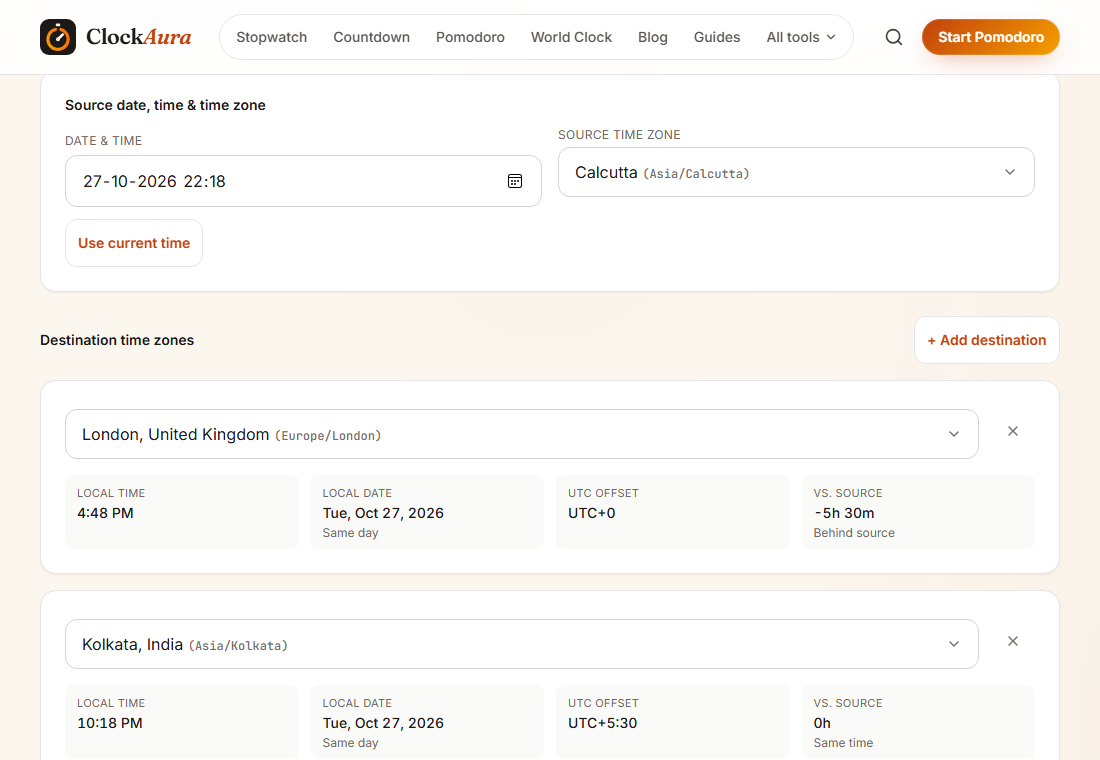
The screenshot above shows the converter comparing cities. To check one of the worked examples:
- Open the time zone converter.
- Add the two places you care about, for example New York and India.
- Set the date and time in the first place, for example 09:00 on a January date.
- Read the matching time in the second place, then change the date to July and watch the gap change from 10:30 to 9:30.
FAQ
Why is India UTC+5:30 and not a whole hour? India uses one time zone for the whole country, and the half-hour offset places it close to the middle of the country's longitude range. It does not use daylight saving time.
Is UTC the same as GMT? For everyday use, the clock time is the same. They are defined differently, and the UK switches from GMT to BST in summer, while UTC never changes.
What is the biggest time difference between two places? Standard offsets run from UTC-12 to UTC+14, so the two most extreme zones are 26 hours apart. That means the same moment can fall on different calendar dates in Pacific islands that are not very far from each other.
How do I avoid mistakes with recurring meetings? Anchor the meeting to one city's time zone in your calendar, and let the calendar app handle conversions for everyone else. Double-check the weeks around clock changes.
Sources
- NIST, Daylight Saving Time (DST)
- Wikipedia, List of UTC offsets