Spaced Repetition: A Simple Review Schedule You Can Run With a Timer
Spaced repetition means reviewing something just as you are about to forget it. You don't need special software to do it. Here is a plain review schedule (day 1, 3, 7, 14, 30), how long each review should take, and how to run the whole thing with a timer and a notebook.
By Om Vaghani, editor at ClockAura (ConnectGo Infoware). Published 31 October 2026.
Most students study a topic once, feel good about it, and then meet it again three weeks later in a test, when most of it has quietly gone. Reading it again the night before feels like learning, but a lot of it is relearning.
Spaced repetition is the simple fix. Instead of one long session, you review the same material several times, with the gaps between reviews getting longer each time. Each review is short, and the total time over a month is often less than one cramming evening.
You don't need an app for this. A notebook, a calendar and a timer are enough. This guide gives you a schedule you can start today, how long each review should take, and what to actually do in those minutes.
The idea in one paragraph
Memory fades fastest just after you learn something, then more slowly. Every time you successfully pull a fact back out of your memory, it fades a little more slowly the next time. So the best moment to review is not straight away (it is still fresh, so the review is too easy) and not much later (it is already gone, so you are starting over). It is somewhere in between, when recalling it takes a bit of effort. Spaced repetition just plans those moments in advance.
The spacing effect has been studied for well over a century. A large 2006 review by Cepeda and colleagues pooled 317 experiments and found that spaced study generally beats massed study, and that the best gap between sessions grows the longer you need to remember the material. The exact best gaps vary by person and subject, so treat any schedule, including the one below, as a sensible default.
A simple schedule to start with
Here is a schedule that works well for most school and university material. "Day 0" is the day you first learn the topic in class or from the book.
| Review | When | Typical length | What you do |
|---|---|---|---|
| Learn | Day 0 | 25-50 min | First study, make notes and questions |
| Review 1 | Day 1 | 10-15 min | Answer your questions from memory |
| Review 2 | Day 3 | 10 min | Answer questions, redo any you missed |
| Review 3 | Day 7 | 5-10 min | Quick recall, focus on weak cards |
| Review 4 | Day 14 | 5-10 min | Mixed recall with other topics |
| Review 5 | Day 30 | 5 min | Final check, then monthly if needed |
Notice two things. First, the reviews get shorter as well as further apart, because you remember more each time. Second, the total time after the first session is roughly 35 to 50 minutes spread over a month. That is less than one evening of cramming.
If you have an exam date, you can squash the gaps to fit. With two weeks left, a schedule of day 1, 3, 6, 10 and 13 still gives you five well-spaced reviews.
What happens in a review
The most important rule: a review is a test, not a reread. Reading your notes again feels easy, and that ease fools you into thinking you know it. Pulling the answer out of your head without looking is harder, and that effort is what makes it stick.
So before each review, you need something to test yourself with. On Day 0, while you study, turn your notes into questions. For example:
- Notes: "Photosynthesis takes place in the chloroplasts and needs light, water and carbon dioxide."
- Questions: "Where does photosynthesis happen?" "What three inputs does it need?"
Write the question on one side of a card or the left side of a page, and the answer on the back or the right side. Twenty to forty questions per topic is a good amount.
In a review session:
- Start your timer.
- Read a question, say or write the answer from memory.
- Check it. Mark it right or wrong honestly.
- Put wrong ones in a "again" pile.
- When you reach the end, go through the "again" pile once more.
- Stop when the timer ends, even if you are not done. Note where you stopped.
Why the timer matters
Without a time limit, reviews either balloon (you start rereading the whole chapter) or get skipped (it feels like a big job). A short, fixed review is easy to start and easy to finish.
For a single 10-minute review, any countdown is enough. If you are doing several topics in one sitting, a Pomodoro timer set to short blocks lets you move from topic to topic with a clear signal. For example, a 25-minute block can hold two 10-minute reviews and a 5-minute catch-up for your "again" pile.
The timer also protects you from a common trap: spending all your time on the topic you enjoy and none on the one you dread. Ten minutes is ten minutes, whichever subject it is.
A worked example: one week, four topics
Say you are a student learning a new biology topic on Monday, a chemistry topic on Tuesday, a history topic on Wednesday and a maths method on Thursday. Using the schedule above (Day 1, 3, 7), here is what your reviews look like:
| Day | New learning | Reviews due | Review time |
|---|---|---|---|
| Mon | Biology | none | 0 min |
| Tue | Chemistry | Biology (R1) | 10 min |
| Wed | History | Chemistry (R1) | 10 min |
| Thu | Maths | Biology (R2), History (R1) | 20 min |
| Fri | none | Chemistry (R2), Maths (R1) | 20 min |
| Sat | none | History (R2) | 10 min |
| Sun | none | Maths (R2) | 10 min |
| Next Mon | new topic | Biology (R3) | 5-10 min |
On the busiest day you spend 20 minutes reviewing. That fits before dinner. By the following Monday, each of the four topics has been reviewed two or three times, and none of it has been crammed.
The workload builds as you add topics, but because later reviews are only about 5 minutes, it grows slowly. If it starts to pass 30 to 40 minutes a day, add fewer new topics per day for a while.
Tracking it without an app
Apps that schedule cards for you are useful, but a paper system works fine and some people stick with it better. Two easy options:
The calendar method. When you learn a topic on Day 0, write its name on your calendar on days 1, 3, 7, 14 and 30. Each morning, look at today's list. That is your review plan for the day.
The box method. Use five envelopes or sections in a box, labelled 1 to 5. New cards start in box 1. If you answer a card correctly, it moves up one box. If you get it wrong, it goes back to box 1. Review box 1 every day, box 2 every other day, box 3 twice a week, box 4 weekly and box 5 every two weeks. Cards you know well naturally get reviewed less, and hard ones keep coming back.
Either way, keep a small log: date, topic, minutes, and how many questions you got right. After two weeks, you will see which topics need more attention.
Common mistakes
Rereading instead of recalling
This is the big one. If your review does not involve answering questions without looking, it is not doing much. Cover your notes.
Making reviews too long
A 45-minute "review" is really a new study session. Keep reviews to 5 to 15 minutes. If a topic needs more, that is a sign the first learning session needs to be redone, not that reviews should grow.
Writing vague questions
"Explain the French Revolution" is not a good card. It has no clear right answer, so you cannot mark yourself honestly. Break it down: "In what year did the storming of the Bastille happen?" "Name two causes of the revolution."
Giving up after a missed day
You will miss a day. Just do the overdue reviews the next day, starting with the oldest. The schedule is a guide, not a contract. A review one day late is still far better than no review.
Only using it before exams
Spaced repetition works best when it starts at the beginning of a course. Starting it three days before an exam is still helpful, but you lose the long gaps that do the real work.
Try it with ClockAura
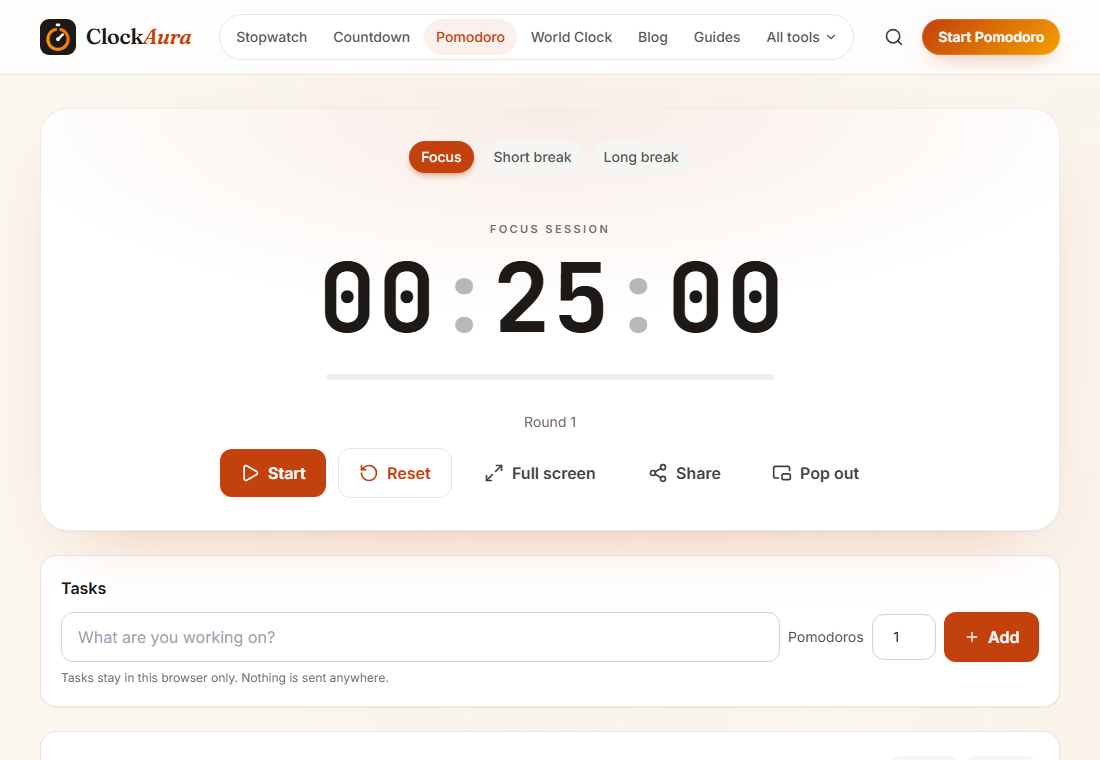
A 25-minute block holds two 10-minute reviews plus a 5-minute pass through your "again" pile. To set it up:
- Open the Pomodoro timer. The link sets 25 minutes focus and 5 minutes break.
- Before pressing start, list today's due topics from your calendar, oldest first.
- Start the timer and switch topics at roughly the 10-minute mark.
- When the break starts, log the date, topics and scores, then step away for the 5 minutes.
How it fits with your other study
Spaced reviews are not a replacement for first learning, practice problems or past papers. They sit alongside them. A good weekly rhythm for many students is:
- Learn new material in focused blocks (see how long you should study without a break)
- Do 20 to 30 minutes of spaced reviews each day, first thing in your study session
- Do practice questions or past papers a few times a week
Putting reviews first is useful because they are short, easy to start, and they warm your brain up for harder work. If you want a ready-made week built around timed blocks, the 7-day Pomodoro study plan fits spaced reviews in neatly.
FAQ
Can I use spaced repetition for maths?
Yes, but review methods and problems rather than facts. Your "question" might be a short problem, and the review is solving it from scratch without looking at a worked example.
What if I have too many reviews on one day?
Do the oldest overdue ones first and cap the session with a timer, for example 30 minutes. Push the rest to tomorrow. Over time, adding fewer new topics per day keeps the review load manageable.
Sources
- Cepeda, Pashler, Vul, Wixted and Rohrer (2006), Distributed practice in verbal recall tasks: a review and quantitative synthesis, Psychological Bulletin 132(3).