The Two-Minute Rule: Clear Small Tasks Before They Pile Up
If a task takes less than two minutes, do it now instead of writing it down. That one rule clears a surprising amount of clutter. Here is how it works, where it goes wrong, and how to batch the small jobs you can't do immediately into a single 15-minute timed sweep.
By Om Vaghani, editor at ClockAura (ConnectGo Infoware). Published 2 November 2026.
Look at any long to-do list and you will usually find a lot of tiny things on it. Reply to a two-line message. Put the parcel by the door. Pay one bill. Book a dentist appointment. None of them is hard. Together, they sit there for days, take up space in your head, and make the list feel much heavier than it is.
The two-minute rule is a simple way to deal with these. It comes from David Allen's Getting Things Done method, and the core idea is easy to remember: if something takes less than two minutes, do it now. Writing it down, remembering it later and coming back to it takes longer than just doing it.
This guide covers how to use the rule, where people go wrong with it, and how to handle the small jobs you can't do right away by batching them into a 15-minute timed sweep.
The rule, plainly
When a new task appears, ask one question: "Can I finish this in under two minutes?"
- Yes: do it now, then carry on with what you were doing.
- No: put it on your list or calendar, to do later at a planned time.
That's the whole rule. Two minutes is not a magic number. It is roughly the point at which tracking a task costs about as much time as doing it. Some people use one minute, some use five. Pick a number and stick with it.
What counts as a two-minute task?
Some everyday examples:
| At home | At work or study |
|---|---|
| Put dishes in the dishwasher | Reply "yes, Thursday works" to a message |
| Hang up your coat | File one document in the right folder |
| Wipe the bathroom sink | Add a meeting to your calendar |
| Take the bins to the door | Forward a file someone asked for |
| Water one plant | Rename a badly named document |
| Pay a bill that's already set up | Write down an idea before you lose it |
| Put clean laundry away from one load | Sign and return a short form |
Notice that all of these are complete. "Start the tax return" is not a two-minute task, even if opening the website takes 30 seconds. The rule is about finishing something, not starting it.
Why it works
Small tasks have a hidden cost
Each unfinished small job needs to be written down, remembered, found again, and reread before you do it. That overhead can easily be longer than the job itself.
Unfinished tasks nag at you
Most people know the feeling of a half-dozen small undone things sitting in the back of their mind. Clearing them reduces that background noise, and many people find it easier to focus on big work afterwards.
It builds momentum
Finishing three small things in five minutes is a quick, real win. It makes starting the next, bigger task easier.
It stops clutter compounding
One mug on the desk is nothing. A week of "I'll do it later" mugs is a job. Small tasks done straight away never grow into big ones.
Common mistakes
The rule is useful, but it has some well-known traps. Allen himself warns against spending your whole day on two-minute jobs.
It can wreck your focus
If you are in the middle of deep work and a two-minute task appears, doing it "now" means breaking your focus. The two-minute rule is best applied when you are already processing tasks, for example going through your inbox, not every time something pops up. During a focused work block, write the small task down and keep going.
Two minutes becomes ten
"Just reply to this one email" turns into reading the whole thread, checking a document, and replying to three others. Be honest. If it's clearly creeping past two minutes, stop and put it on the list.
A day of nothing but small tasks
You can spend a whole day clearing tiny jobs and feel busy without touching anything important. Small tasks are easy, which is exactly why they are tempting. Make sure your important work has its own protected time first.
Batching: the 15-minute sweep
What about small tasks that turn up while you are busy, or that you can't do on the spot? This is where batching helps. Instead of handling them one at a time throughout the day, collect them and clear them in one short, timed session.
Here's how:
- Keep a capture list. One place, paper or a notes app, where every small task goes when it appears. Don't sort it, just write it down.
- Schedule one or two sweeps a day. For example, just after lunch and at the end of the working day.
- Set a 15-minute timer. A 15 minute timer is the right size for most people. Long enough to clear a good handful of jobs, short enough to stay brisk.
- Work down the list, fast. Do each item fully. No reorganising, no starting big tasks.
- Stop when the timer ends. Anything left goes to the next sweep or, if it has turned out to be bigger, onto your main task list with its own slot.
A worked example
Here is what a real sweep might look like at the end of a work-from-home day. The capture list has 9 items.
| Item | Time taken |
|---|---|
| Reply to colleague confirming meeting time | 1 min |
| Order printer ink (saved basket) | 2 min |
| Move invoices into the "paid" folder | 2 min |
| Text plumber to confirm Tuesday | 1 min |
| Add dentist reminder to calendar | 1 min |
| Unload the dishwasher | 4 min |
| Fill in short school permission form | 3 min |
| Reply to neighbour about parcel | 1 min |
| Look up return policy for a jacket | started, more than 2 min |
Eight items, 15 minutes of work, done in one sweep. The last one turned out to be bigger (finding the receipt, reading the policy, printing a label), so it moves to tomorrow's list as a proper 20-minute task.
Without the sweep, those eight things would probably have been scattered across the day as interruptions, or left for the weekend. With it, they are done in one quarter of an hour.
How many sweeps do you need?
| Situation | Suggested sweeps |
|---|---|
| Light day, few messages | 1 sweep of 15 min |
| Normal office or study day | 2 sweeps of 15 min |
| Busy day, lots of admin | 2-3 sweeps of 15 min |
| Home weekend reset | 2 sweeps of 15 min, one morning, one evening |
If your sweeps regularly run out of time with lots left, you either have too many small tasks coming in, or some of them are not really small. Look at what is left over and move the bigger ones to planned time.
Using it at home
The two-minute rule is especially good for keeping a home under control. A few habits that make a noticeable difference:
- The "don't put it down, put it away" rule. When you pick something up, take it to where it lives rather than to the nearest surface.
- The closing sweep. Before bed, set a 10-minute timer and the whole household tidies up together. Many hands make it a quick job, and the timer stops it feeling endless.
- One-touch mail. Open post at the bin. Recycle junk at once, deal with anything under two minutes, and put the rest in one tray.
Children often respond well to timed sweeps too. "Beat the timer" is far more fun than "tidy your room". A visual timer works well for younger kids who can't read a clock yet.
Using it alongside bigger methods
The two-minute rule handles the small stuff. Your big tasks need a different approach. Two that fit well:
- Timeboxing: give each important task a fixed slot on your calendar. Decide in advance how long each task is worth, and stop when that time is up.
- Pomodoro: work in focused blocks with short breaks, using a Pomodoro timer. Write down any small tasks that come up during a block and clear them in your next sweep.
A balanced day often looks like: focused blocks for the important work in the morning, a 15-minute sweep after lunch, more focused work, then a final sweep before you finish.
FAQ
What is the two-minute rule?
If a task will take less than two minutes, do it now instead of adding it to a list. Tracking and coming back to tiny tasks often takes longer than just doing them.
Should I always do two-minute tasks immediately?
Not always. If you are in the middle of focused work, write the task down and keep going. Do it in your next batch or sweep. The rule is best used while you are already processing tasks, like going through email.
How is a 15-minute sweep different from the two-minute rule?
The two-minute rule decides what to do immediately. A 15-minute sweep is a planned, timed session to clear a collected list of small tasks in one go, so they don't interrupt you throughout the day.
What if a task takes longer than I expected?
Stop when it is clearly past two minutes and move it to your main list with its own time slot. That keeps small-task time from quietly turning into an hour.
Does the two-minute rule work for building habits?
A related idea is to start a new habit with a version so small it takes two minutes, like reading one page or doing one stretch. It lowers the barrier to starting. Once it is routine, you can make it longer.
Try it with ClockAura
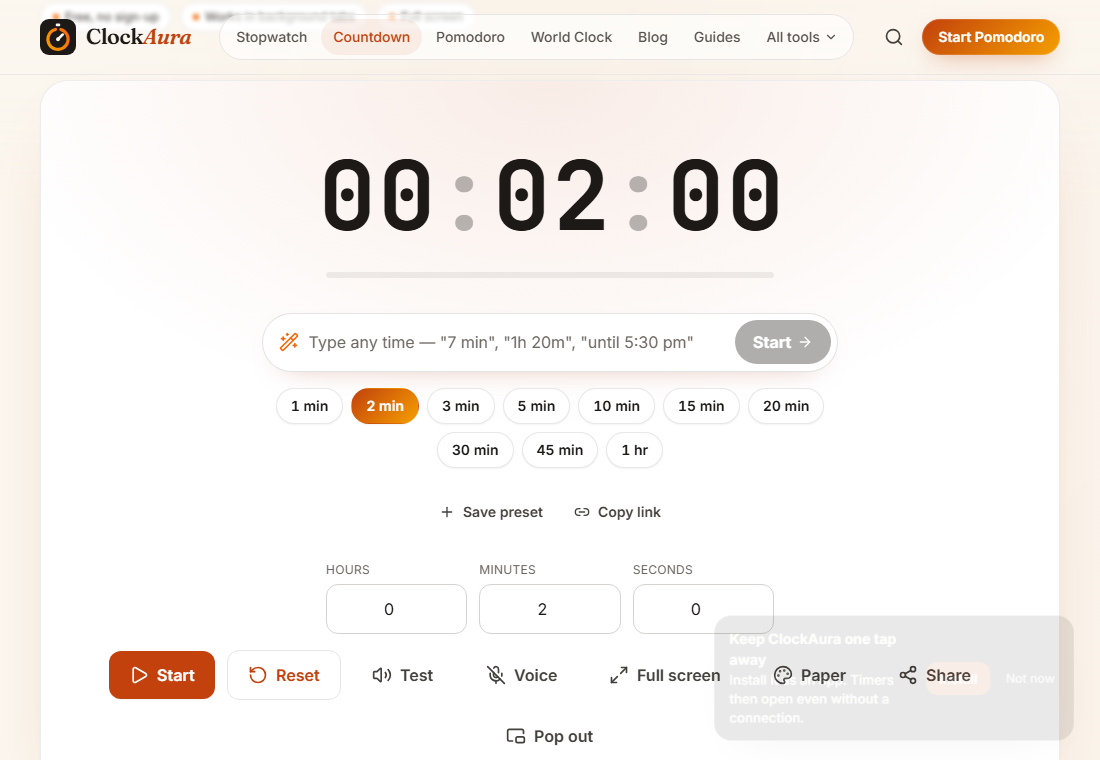
If you are not sure whether a job really is a two-minute job, time it once. We set the countdown to 2 minutes for the screenshot above.
- Open the countdown timer set to 2 minutes.
- Press start as you begin the task.
- If the alarm goes off before you finish, it was not a two-minute task. Note how long it really took and put it on your main list.
- For a batch sweep, change the time to 15 minutes and work down your capture list.
Sources
- David Allen, Episode #79: The Two-minute Rule, Getting Things Done.
