EMOM, Tabata and AMRAP Timers Explained
How EMOM, Tabata and AMRAP work, how to calculate the total time of each, and six ready-to-use workouts with one-click timer links.
EMOM, Tabata and AMRAP are the three workout formats you will see written on gym whiteboards more than any others. All three are built around a clock, but each uses it in a different way. EMOM gives you a fixed window to do a fixed job. Tabata gives you very short bursts of work with even shorter rests. AMRAP gives you one long window and asks how much you can fit in.
Mixing them up leads to badly set timers, workouts that run three minutes longer than planned, and rest periods that vanish. This guide explains how each format works, how to calculate the total time correctly, and gives six ready-made workouts with links that open the timer already set up.
A quick safety note: pick exercises you can do with good form while tired. All three formats get harder as the clock runs, and that is when technique slips.
The three formats side by side
| EMOM | Tabata | AMRAP | |
|---|---|---|---|
| Stands for | Every minute on the minute | Named after Izumi Tabata, a Japanese researcher | As many rounds (or reps) as possible |
| How the clock works | A new interval starts every minute | 20 s work, 10 s rest, repeated | One countdown for the whole workout |
| Your rest | Whatever is left of the minute | Fixed 10 s | Whenever you choose to take it |
| What you measure | Did you finish the reps in time? | Reps per 20 s, or just completing it | Rounds and reps completed |
| Typical length | 10 to 30 min | 4 min per block | 5 to 20 min |
| ClockAura timer | /emom-timer | /tabata-timer | /interval-timer set to one round |
EMOM: every minute on the minute
At the start of each minute, you do a set number of reps. Whatever time is left before the next minute begins is your rest. If the reps take 40 seconds, you rest for 20. If they take 55 seconds, you rest for 5.
That makes EMOM self-correcting. Choose a rep count that leaves 15 to 25 seconds of rest in the early rounds. If you cannot finish the reps inside the minute for two rounds in a row, the load or rep count is too high; drop it rather than letting the workout fall apart.
How to work out EMOM total time
Total time = number of rounds × interval length.
There is no separate rest to add, because the rest lives inside each interval.
| Format | Rounds | Interval | Total time |
|---|---|---|---|
| EMOM 10 | 10 | 1 min | 10 min |
| EMOM 16 | 16 | 1 min | 16 min |
| EMOM 20 | 20 | 1 min | 20 min |
| E2MOM 6 (every 2 minutes) | 6 | 2 min | 12 min |
| E90S 8 (every 90 seconds) | 8 | 1 min 30 s | 12 min |
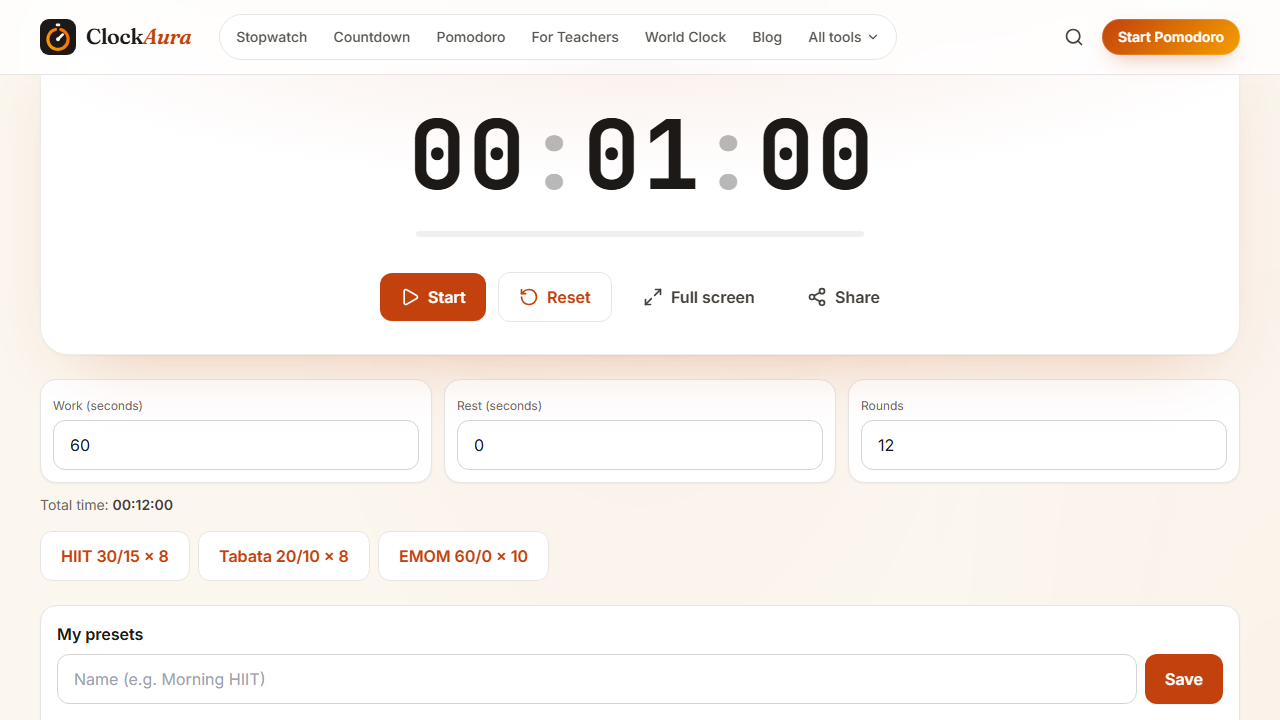
On the EMOM timer, the interval is the Work box (60 seconds by default) and Rest is set to 0, so a sound marks the start of every new interval. For an every-two-minutes workout, set Work to 120.
Tabata: 20 seconds on, 10 seconds off
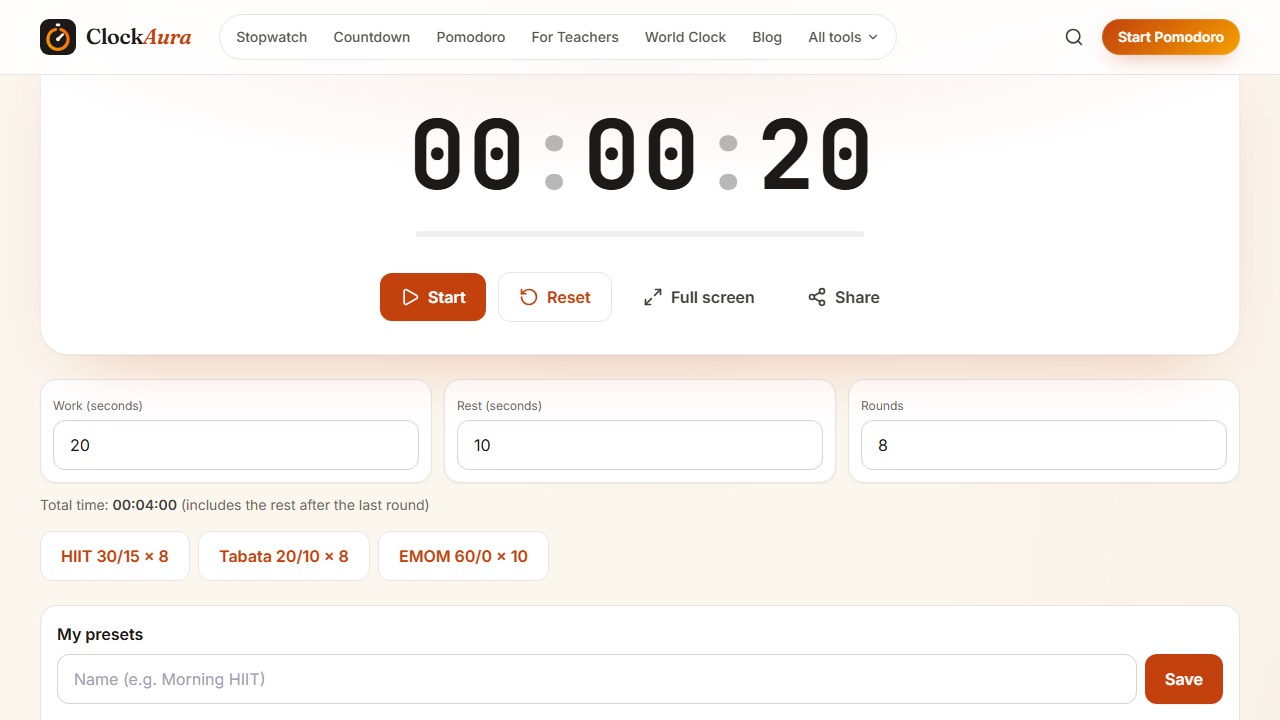
A Tabata block is 8 rounds of 20 seconds of very hard work and 10 seconds of rest. The format comes from a 1996 study led by Izumi Tabata, which used this pattern on exercise bikes with trained athletes working at a very high intensity. Most gym Tabatas are a looser version of the same shape, done with bodyweight moves or light weights.
The 20/10 timing only works if the work really is hard. If you could talk comfortably through every round, it is a pleasant interval session rather than a Tabata, which is fine, but worth knowing.
How to work out Tabata total time
One block = 8 × (20 s + 10 s) = 240 seconds = 4 minutes.
Some people stop the clock at the end of the eighth work period and call it 3 minutes 50 seconds, because the final 10-second rest doesn't really count. ClockAura's timer includes that last rest and shows 4:00, which is the figure most workout plans use.
For several blocks, add the rest you take between them:
Total = (blocks × 4 min) + ((blocks − 1) × rest between blocks).
| Blocks | Rest between blocks | Total time |
|---|---|---|
| 1 | None | 4 min |
| 2 | 1 min | 9 min |
| 4 | 1 min | 19 min |
| 4 | None, run straight through | 16 min |
AMRAP: as many rounds as possible
An AMRAP sets one time limit and a short circuit of exercises. You work through the circuit again and again until time runs out, then count how many full rounds plus extra reps you completed. You rest whenever you need to, but the clock never stops.
The score is the point. Write it down as rounds plus reps, for example "6 + 9", meaning six full rounds and nine reps into the seventh. Repeat the same AMRAP a few weeks later and you have a simple test of whether you are improving.
How to work out AMRAP total time
Total time = the time cap. A 12-minute AMRAP takes 12 minutes, regardless of how many rounds you get through.
The only planning question is the circuit. Aim for a round that takes about 1 to 2 minutes when fresh, so you complete somewhere between 5 and 12 rounds in a typical AMRAP. Very long rounds make the score hard to compare from one week to the next.
To time an AMRAP, use the interval timer with one long work period, no rest and a single round. For example, 720 seconds is 12 minutes.
Six ready-to-use workouts
Each link opens the timer with the settings already filled in. Press Start (or Space) and go. Press F for full screen if the timer is on a TV or across the room.
| # | Workout | Format | Settings | Total time | One-click link |
|---|---|---|---|---|---|
| 1 | Beginner full body | EMOM 10 | 60 s × 10 rounds | 10 min | /emom-timer |
| 2 | Swings and push-ups | EMOM 16, alternating | 60 s × 16 rounds | 16 min | /emom-timer?rounds=16 |
| 3 | Strength sets | E2MOM 6 | 120 s × 6 rounds | 12 min | /emom-timer?work=120&rest=0&rounds=6 |
| 4 | Classic squat Tabata | Tabata | 20 / 10 × 8 | 4 min | /tabata-timer |
| 5 | Four-move Tabata | Tabata × 4, no breaks | 20 / 10 × 32 | 16 min | /tabata-timer?rounds=32 |
| 6 | Twelve-minute circuit | AMRAP 12 | 720 s × 1 round | 12 min | /interval-timer?work=720&rest=0&rounds=1 |
1. Beginner full body (EMOM 10)
Every minute: 8 bodyweight squats, 6 push-ups (on your knees is fine), 4 reverse lunges per leg. This should take 35 to 45 seconds, leaving a comfortable rest. If you finish in under 30 seconds by round three, add two squats next time.
2. Swings and push-ups (EMOM 16, alternating)
Odd minutes: 12 kettlebell swings. Even minutes: 8 to 10 push-ups. Alternating gives each movement a full two minutes of recovery, which is why alternating EMOMs can run longer than single-movement ones. You get 8 sets of each.
3. Strength sets (E2MOM 6)
Every two minutes: one set of 5 goblet squats or 5 deadlifts at a weight you could lift about 8 times. The longer interval leaves enough rest for heavier work. Six sets of five is a solid strength session in 12 minutes.
4. Classic squat Tabata
Eight rounds of 20 seconds of bodyweight squats, 10 seconds rest. Count your reps each round and write down the lowest number. That lowest round is the traditional Tabata score, and beating it next time is a good goal.
5. Four-move Tabata (16 minutes)
Run 32 rounds without stopping and change the exercise every 8 rounds: squats, then push-ups, then mountain climbers, then jumping jacks or step-jacks. The timer shows the round number, so moves change after rounds 8, 16 and 24. Prefer a minute off between moves? Run /tabata-timer four times with a one-minute break each time, which makes 19 minutes in total.
6. Twelve-minute circuit (AMRAP 12)
As many rounds as possible of: 10 kettlebell swings, 10 sit-ups, 10 step-ups (5 per leg). Rest only when you need to. Record your score as rounds plus reps. A first attempt often lands somewhere around 5 to 8 rounds, but that varies a lot with fitness and equipment, so treat your own first score as the baseline.
Setting up the timer for a class or home gym
- Put it on the biggest screen you have. Press F for full screen, or cast the browser tab to a TV. The digits scale to fill the display.
- Turn the sound up. You will be listening for the start of each interval, not watching the screen. The end of a work period plays a chime and the end of a rest plays a beep.
- Check the total before you start. The interval timer shows the total time under the settings, including the rest after the last round, so you can spot a wrong round count before you begin.
- Save your favourites. The My presets box under the interval timer lets you name and save a setup, such as "Thursday EMOM".
- Keep the screen on. The page asks the browser to keep the screen awake while the timer runs, so a phone propped on a bench shouldn't lock mid-workout.
Frequently asked questions
How long is a Tabata workout?
One Tabata block is 8 rounds of 20 seconds of work and 10 seconds of rest, which is 4 minutes. Workouts usually stack several blocks; four blocks with a minute of rest between them take 19 minutes.
How do you calculate EMOM total time?
Multiply the number of rounds by the length of each interval. An EMOM 12 is 12 minutes, and an every-2-minutes EMOM with 8 rounds is 16 minutes. Rest is already inside each interval, so you don't add it separately.
What is the difference between EMOM and AMRAP?
EMOM gives you a fixed number of reps at the start of each minute and you rest for whatever is left. AMRAP gives you one long time limit and you do as many rounds as you can, resting when you choose. EMOM controls the pace for you; AMRAP lets you set it.
Can I use an interval timer for AMRAP?
Yes. Set the work time to the AMRAP length in seconds, rest to 0 and rounds to 1. For a 12-minute AMRAP that is 720 seconds of work, one round.
Is Tabata the same as HIIT?
Tabata is one specific type of HIIT (high-intensity interval training) with a fixed 20 seconds on, 10 seconds off, for 8 rounds. HIIT is the broader category and includes any work and rest pattern, such as 30/15 or 40/20.
What if I can't finish my EMOM reps within the minute?
Lower the reps or the weight for the next round. Failing to finish two rounds in a row means the workload is too high. EMOMs work best when you have at least 10 to 15 seconds of rest at the start.