HIIT Work-to-Rest Ratios Explained: 1:1, 2:1 and 1:2
The ratio between work and rest decides how a HIIT session feels and what it trains. Here is what 1:1, 2:1 and 1:2 mean in practice, sample sessions for beginners and intermediates, and how to set them up on a free interval timer.
By Om Vaghani, editor at ClockAura (ConnectGo Infoware). Published 27 October 2026.
Two HIIT workouts can use the same exercises and last the same 20 minutes, yet feel completely different. One leaves you breathing hard but in control. The other has you bent over, wondering why you started. Very often, the difference is not the moves. It is the ratio between work and rest.
The work-to-rest ratio is the simplest dial you have in interval training. Change it and you change how hard each round feels, how many good rounds you can do, and what kind of fitness you are building.
What a work-to-rest ratio is
The ratio compares how long you work to how long you rest in each round.
- 1:1 means equal work and rest, for example 30 seconds on, 30 seconds off.
- 2:1 means twice as much work as rest, for example 40 seconds on, 20 seconds off.
- 1:2 means twice as much rest as work, for example 20 seconds on, 40 seconds off.
That is all it is. The numbers do not tell you how hard to go. That depends on the exercise and on you. But the ratio strongly shapes the effort you can keep up.
Why the ratio matters
When you work hard, your body builds up a short-term "debt" that it pays back while you rest. Breathing and heart rate stay up for a while after you stop.
- More rest lets you recover more fully, so each work interval can be harder and better quality.
- Less rest means you start each round still partly tired. The intensity of each interval drops a little, but the session as a whole feels more continuous and demanding.
So there is a trade-off. Long rest favours intensity and quality per interval. Short rest favours density and overall effort. Neither is better. They suit different goals and different fitness levels.
The three ratios compared
| Ratio | Example | How it feels | Good for |
|---|---|---|---|
| 1:2 | 20 s work / 40 s rest | Hard bursts, real recovery | Beginners, sprints, learning good form, very high-effort moves |
| 1:1 | 30 s work / 30 s rest | Steady and challenging | Most people, general fitness, circuits |
| 2:1 | 40 s work / 20 s rest | Dense, little recovery | Intermediates, conditioning, shorter sessions |
1:2 - more rest than work
This is the friendliest ratio for beginners and the best one for very hard efforts. With twice as long to recover, you can push each short burst properly and keep your form tidy.
It is also the usual choice for true sprint work, such as all-out cycling or running efforts, where the aim is to go very hard for a short time. Without enough rest, those sprints quickly turn into a medium-paced jog.
1:1 - equal work and rest
The all-rounder. Thirty seconds on and thirty off is easy to remember, gives enough recovery to keep moving well, and is still clearly challenging. Many circuit classes are built around this ratio. If you are unsure where to start and you already exercise a little, start here.
2:1 - more work than rest
This is where things get tough. Short rests mean your heart rate stays high throughout. The well-known Tabata format, 20 seconds on and 10 seconds off for eight rounds, is a 2:1 ratio. So is 40 seconds on, 20 off.
Because you never fully recover, the intensity of each interval naturally drops as the session goes on. That is expected. The aim is to keep going steadily, not to sprint every round. This ratio suits people who already have a base of fitness. You can read more about Tabata and similar formats in our post on EMOM, Tabata and AMRAP timers.
Sample sessions
Always begin with a 5-minute warm-up of easy movement, such as marching, gentle jogging on the spot, arm circles and bodyweight squats. Finish with a few minutes of walking and light stretching.
Beginner: 1:2, about 15 minutes
- Ratio: 20 seconds work, 40 seconds rest
- Rounds: 12 (12 minutes), plus warm-up and cool-down
- Exercises, in a loop: bodyweight squats, wall or knee push-ups, marching high knees, glute bridges
Each exercise comes up three times. Aim for steady, controlled reps. You should finish feeling like you worked, not like you are about to collapse.
Beginner to intermediate: 1:1, about 20 minutes
- Ratio: 30 seconds work, 30 seconds rest
- Rounds: 16 (16 minutes), plus warm-up and cool-down
- Exercises, in a loop: squats, push-ups, reverse lunges, a plank hold, jumping jacks, mountain climbers, glute bridges, fast feet
Each exercise appears twice. If 30 seconds is too long for push-ups or planks at first, do fewer good reps and rest for the remainder of the interval.
Intermediate: 2:1, about 20 minutes
- Ratio: 40 seconds work, 20 seconds rest
- Rounds: 3 blocks of 5 rounds, with 1 minute of rest between blocks (about 17 minutes)
- Exercises per block: jump squats or fast squats, push-ups, alternating lunges, mountain climbers, burpees or squat thrusts
Keep the pace you could hold for every round, not just the first one. If your form breaks down, slow down or swap the jump for a non-jumping version.
Worked example: same time, different ratio
Here is what 10 minutes of one exercise, say squats, looks like at each ratio.
| Ratio | Work / rest | Rounds in 10 min | Total work time |
|---|---|---|---|
| 1:2 | 20 s / 40 s | 10 | 3 min 20 s |
| 1:1 | 30 s / 30 s | 10 | 5 min |
| 2:1 | 40 s / 20 s | 10 | 6 min 40 s |
Same ten minutes, but the 2:1 version has twice as much work as the 1:2 version. That is why it feels so much harder, and why it is not where most beginners should start.
Try it with ClockAura
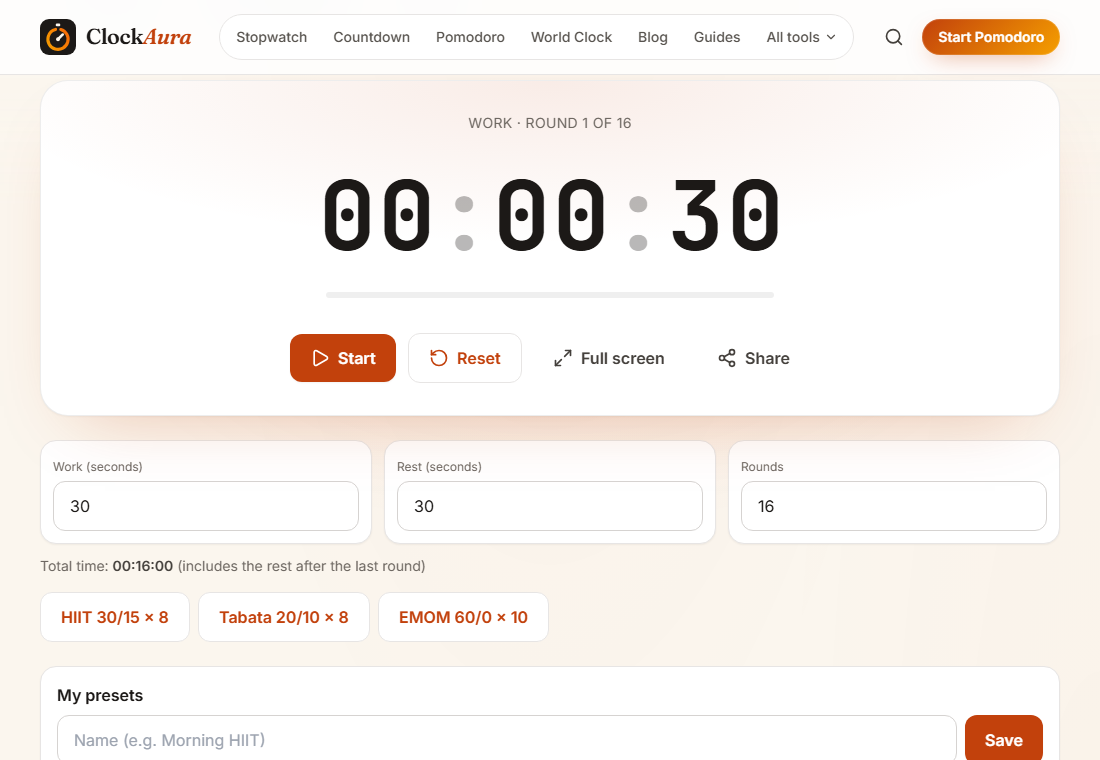
We set the timer to 30/30 for 16 rounds for the screenshot above, which is the 1:1 sample session.
- Open the interval timer with 30/30 x 16 loaded.
- To switch ratio, change the work and rest fields: 20 and 40 for 1:2, or 40 and 20 for 2:1.
- Set the rounds to match your plan, for example 12 for the beginner session.
- Prop the screen where you can see it from the floor, turn the volume up and press start. It signals every switch between work and rest.
For 20 seconds on, 10 seconds off, the Tabata timer has that format ready to go.
Common mistakes
- Starting at 2:1 because it looks efficient. If your reps fall apart by round four, the ratio is too hard for now. Drop to 1:1 or 1:2.
- Sprinting the first round. Pick a pace you could repeat in the last round. Even effort beats a fast start and a slow finish.
- Skipping the warm-up. Five minutes of easy movement makes the first hard interval feel far better and is kinder to your joints.
- Counting rest as a chance to check your phone. Use rest to breathe and get into position for the next move, so you start on the beep.
- Doing HIIT every day. Hard sessions need easier days around them. Two or three a week is plenty for most people.
How to progress over time
Change one thing at a time, and only when the current session feels manageable for two or three workouts in a row.
- Add rounds at the same ratio. 12 rounds becomes 14, then 16.
- Shift the ratio gradually. Move from 20/40 to 25/35, then to 30/30.
- Choose harder exercises. Knee push-ups become full push-ups. Squats become jump squats.
Two or three HIIT sessions a week is plenty for most people, with lighter activity or rest on the days between. More is not better if it leaves you constantly sore or tired.
Safety note
HIIT is demanding on the heart, lungs and joints. The NHS counts interval running and circuit training as very vigorous activity, the kind that makes it hard to say more than a few words. If you have a heart condition, high blood pressure, are pregnant, have a recent injury, or have not exercised in a long time, check with a doctor before starting. Stop straight away if you feel chest pain, dizziness, faintness or unusual shortness of breath. Use low-impact versions of jumping exercises if your knees, ankles or back complain. Drink water, and warm up every time.
FAQ
What is the best work-to-rest ratio for burning fat? There is no single best ratio. The one you can do consistently, with good form, two or three times a week, is the one that helps most. For most beginners that means 1:2 or 1:1.
Is Tabata suitable for beginners? Proper Tabata is a 2:1 ratio done at a very high effort, so it is tough. Beginners can try it with gentle exercises, or start with a 1:2 or 1:1 session and build up.
How long should a HIIT session be? The intervals themselves usually last 10 to 25 minutes. With a warm-up and cool-down, the whole session is often 20 to 35 minutes.
Can I mix ratios in one workout? Yes. A common approach is to start with 1:1 rounds and finish with a short 2:1 block. Just plan it in advance and set the timer for each part.