Pressure Cooker Whistles to Minutes: Dal, Rice, Chana and Rajma
Three whistles mean something different on every stove and every cooker. Here is why whistles vary, a table that turns whistles into minutes for dal, rice, chana and rajma, soaking times, and how to use a timer for more consistent results.
By Om Vaghani, editor at ClockAura (ConnectGo Infoware). Published 1 November 2026.
In most Indian kitchens, cooking time is not measured in minutes. It is measured in whistles. Toor dal is "three whistles". Rice is "two". Rajma is "six or seven, then simmer". These rules are passed down from parents and grandparents, and they mostly work.
Until you change something. A new cooker, a bigger burner, a smaller batch, a move to an induction hob, and suddenly the dal that always came out perfect is either still firm or has turned to paste. The whistle has not changed. Everything around it has.
Below: what a whistle is, why the count varies, how to switch to a timer, soaking times and safe pressure release.
What a whistle actually means
A stovetop pressure cooker traps steam, which raises the pressure inside. Higher pressure means water boils at a higher temperature than in an open pot, so food cooks faster.
The weight on top of the lid (the whistle) sits over a small vent. When the pressure inside is high enough, steam lifts the weight and escapes with that familiar sound. The weight then drops back, pressure builds again, and the next whistle comes.
So a whistle is not a unit of time. It is a sign that the cooker has reached full pressure and released some steam. The time between whistles depends on how fast the cooker is being heated.
Why whistle counts vary so much
Several things change how long "three whistles" takes:
- Flame or heat setting. On high heat, whistles come quickly, maybe every minute or so. On low heat, they can be several minutes apart, or stop entirely.
- Amount of water and food. A full cooker takes longer to reach pressure and longer between whistles than a half-empty one.
- Cooker size and brand. A 5-litre cooker and a 2-litre cooker behave very differently. Weights also vary between makers.
- Gas vs induction vs electric. Induction often heats faster, so whistles arrive sooner.
- Altitude. At high altitude, water boils at a lower temperature, so food may need longer.
- Age of the gasket. A worn rubber ring leaks steam and slows pressure build-up.
Two people can both cook "three-whistle dal" and one ends up with three minutes of cooking under pressure while the other has twelve. That is why your mother's whistle count might not work in your kitchen.
Why a timer gives more consistent results
The method many experienced cooks settle on is simple:
- Cook on high heat until the first whistle. This tells you the cooker is at full pressure.
- Turn the heat down to low or medium-low.
- Start a timer for the minutes the dish needs.
- Turn off the heat when the timer goes, and let the pressure release.
On low heat, the cooker stays at pressure without whistling repeatedly, which also means less water lost as steam and less mess on the stove. The timer, not the whistle count, now controls the cooking. If you change your cooker or your stove, the minutes stay the same.
A countdown timer set for the right number of minutes after the first whistle works well.
Whistles to minutes: a practical table
The minutes below are counted after the first whistle, on low heat. They are common household starting points, not lab-tested figures, for a standard 3 to 5 litre stovetop cooker. Your cooker and your preferred texture may need small adjustments, so make a note of what works and stick with it.
| Dish | Soaking | Typical whistle count (high heat) | Minutes after first whistle (low heat) |
|---|---|---|---|
| White rice (sona masoori, regular) | Rinse; optional 15-20 min | 2 | 2-4 min |
| Basmati rice | 20-30 min | 1-2 | 1-3 min |
| Toor / arhar dal | Rinse; optional 30 min | 3-4 | 6-8 min |
| Moong dal (yellow, split) | Rinse; optional 15-20 min | 2-3 | 4-5 min |
| Masoor dal (red, split) | Rinse only | 2 | 3-4 min |
| Chana dal | 1-2 hours | 3-4 | 8-10 min |
| Whole moong | 4-6 hours | 4-5 | 10-12 min |
| Kabuli chana (chickpeas) | 8 hours or overnight | 6-8 | 15-20 min |
| Kala chana (black chickpeas) | 8 hours or overnight | 7-8 | 20-25 min |
| Rajma (kidney beans) | 8 hours or overnight | 6-8 | 15-20 min |
For unsoaked kabuli chana or kala chana, cooking times can double or more, and the texture is often uneven. Soaking is strongly recommended.
A note on rajma
Raw or undercooked red kidney beans contain a natural lectin (phytohaemagglutinin) that can cause severe vomiting. It is destroyed by thorough boiling: Kansas State University's food-safety advice is to soak dry kidney beans for at least five hours, drain, boil in fresh water for at least 30 minutes, and not rely on a slow cooker, which may not get hot enough. A pressure cooker runs hotter than an open boil, but the principle is the same. Always soak rajma, discard the soaking water, and cook until the beans are completely soft and can be crushed easily between your fingers. If they are at all firm after pressure cooking, cook them longer.
How much water to use
Water is the other half of the result. These ratios are by volume, using the same cup for both:
| Dish | Water ratio |
|---|---|
| White rice | 1 cup rice : 2 to 2.5 cups water |
| Basmati rice | 1 cup rice : 1.5 to 2 cups water |
| Toor or moong dal | 1 cup dal : 3 to 3.5 cups water |
| Masoor dal | 1 cup dal : 2.5 to 3 cups water |
| Soaked chana or rajma | Enough to cover by about 2-3 cm |
Never fill a pressure cooker more than about two-thirds full, and no more than half full for dal and beans, which foam as they cook. Always check your cooker's own manual for its minimum water and maximum fill lines.
A worked example: toor dal and rice for dinner
Say you want dal and rice ready by 8:00 pm, and you have one cooker.
Dal first. 1 cup toor dal, rinsed, soaked for 30 minutes, with 3 cups water, a pinch of turmeric and a few drops of oil.
- 7:10 pm: cooker on high heat.
- About 7:18 pm: first whistle. Heat to low, start an 8-minute timer.
- 7:26 pm: timer goes. Turn off the heat. Let the pressure release naturally, about 10 to 15 minutes.
- About 7:40 pm: open, mash lightly, then make the tadka in a separate pan and add it.
Rice next. While the dal pressure drops, rinse 1 cup rice and soak it for 15 minutes. Once the cooker is free and washed, add rice and 2 cups water.
- 7:42 pm: cooker on high heat.
- About 7:48 pm: first whistle. Heat to low, start a 3-minute timer.
- 7:51 pm: turn off. Let the pressure release naturally.
- About 8:00 pm: open and fluff the rice.
Two dishes, two timers, and the same result every time you repeat it. If you have two cookers, you can run both at once with two labelled timers.
Releasing pressure safely
This is the part that matters most. Pressure cookers are safe when used properly, but steam under pressure can cause serious burns.
Natural release is the safest method and the right choice for dal, beans, chana and rajma. Turn off the heat and wait until the pressure drops on its own, usually 10 to 20 minutes. The food also finishes cooking gently during this time, which is why many recipes count on it.
Quick release means lifting the weight or using the release valve to let steam out fast. If you do this:
- Use a long spoon or tongs, never your bare hand.
- Keep your face, arms and hands away from the vent.
- Do not quick-release dal or beans. They foam and can spray hot liquid through the vent.
Never force the lid open. If the lid does not turn easily, there is still pressure inside. Wait. Do not run the cooker under cold water unless your cooker's manual says this is safe for your model.
Other safety basics:
- Check that the vent is clear and the gasket is in good condition before each use.
- Do not leave a pressure cooker unattended on high heat.
- Replace worn gaskets and safety valves as the maker recommends.
- If the cooker hisses from the edges of the lid instead of the whistle, turn off the heat and let it cool before checking the gasket.
Common mistakes
- Counting whistles on high heat. Five fast whistles can mean only a few minutes at pressure. Time from the first whistle instead.
- Overfilling. Dal and beans foam; keep them to half the cooker or less.
- Quick-releasing dal or beans. Foam can spray through the vent. Use natural release.
- Stopping rajma when the count is done rather than when it is soft. Texture, not whistles, tells you it is cooked.
- Ignoring a tired gasket. Steam leaking round the lid slows pressure build-up and makes timings unreliable.
Try it with ClockAura
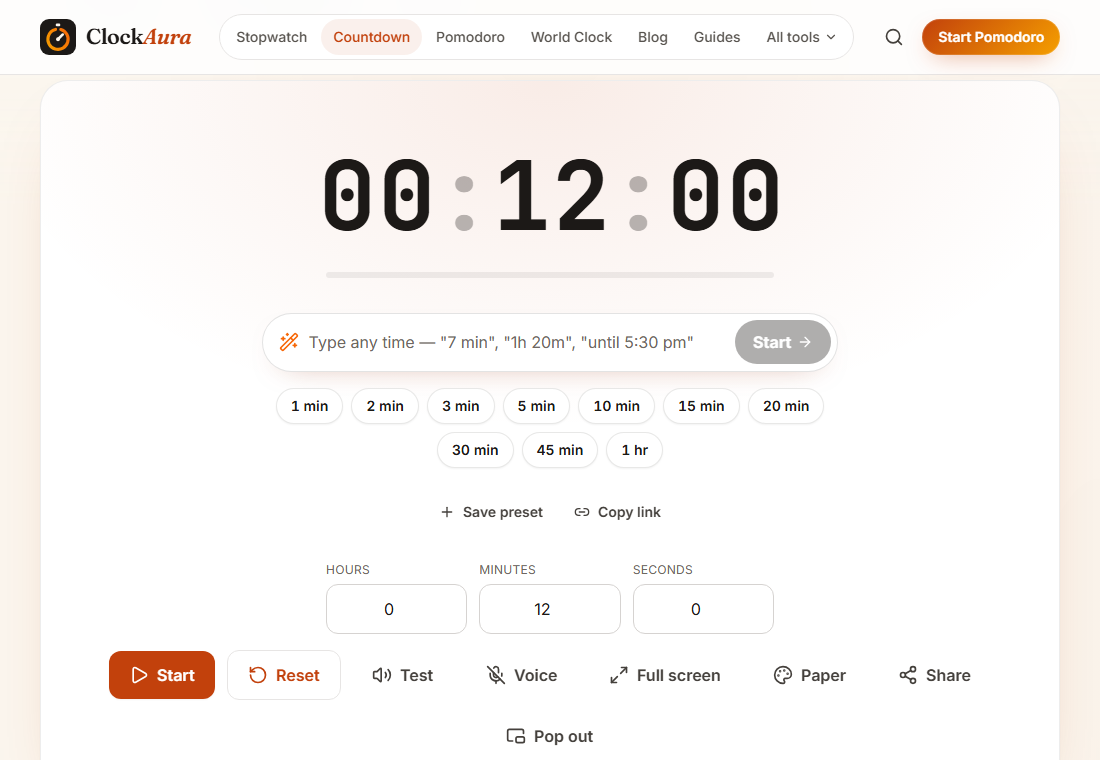
We set the countdown to 12 minutes for the screenshot, the top of the whole moong range in the table.
- Put the cooker on high heat and wait for the first whistle.
- Turn the heat to low and open the countdown timer set to 12 minutes. Change the minutes to match your dish.
- Press start. When the alarm sounds, turn off the heat.
- Let the pressure release naturally, and write down the minutes that gave you the texture you like.
FAQ
Why does my dal sometimes stay firm even after many whistles? Usually because the heat was high and the whistles came very fast, so the actual time at pressure was short. Old dal also takes longer. Switch to timing after the first whistle on low heat.
Can I use these times in an electric pressure cooker? Electric multi-cookers often run at slightly lower pressure than stovetop cookers, so they may need a few more minutes. Follow the appliance's own guide as a starting point.
Is soaking really necessary? For split dals, it is optional but helps them cook evenly. For whole chana, rajma and whole moong, soaking makes a large difference to time and texture, and for rajma it is part of cooking it safely.
What if water spurts out of the whistle? The cooker is probably too full or the heat is too high. Turn off the heat, let it release naturally, and use less water or a lower flame next time.
For rice on the stove instead, see our guide on how long to cook rice.
Sources
- Kansas State University, Cooking dry beans safely