Run-Walk Intervals for Beginners: An 8-Week Plan
Run-walk intervals let a new runner build up to 20 or 30 minutes of running without the misery of going out too hard. Here is a gentle 8-week plan, the exact minutes for every week, and how to set it up on a free interval timer so you never have to look at your watch.
By Om Vaghani, editor at ClockAura (ConnectGo Infoware). Published 30 October 2026.
A common reason beginners give up running is that the first runs are too hard. They set off at a pace that felt fine for ninety seconds, ran out of breath by minute three, walked home feeling like running "is not for them", and never tried again.
Run-walk intervals fix that problem. Instead of trying to run for as long as you can, you run for a short, planned stretch, walk for a short, planned stretch, and repeat. The walking is not a failure. It is part of the workout, and it is what lets you finish feeling like you could have done a little more.
Why run-walk works for beginners
Short running segments with walking in between keep the total load on your legs modest while you build a habit. It is the same idea behind the NHS Couch to 5K plan, which starts with 1-minute runs and 90-second walks, three times a week, over 9 weeks.
There are three practical benefits:
- You finish every session. A plan you can complete is a plan you will repeat.
- You can hold an easy pace. Knowing a walk is coming in a minute or two stops you from sprinting.
- Progress is visible. Going from 1-minute runs to 10-minute runs in a few weeks is a clear, satisfying change.
How hard should the running feel?
Slower than you think. A useful test is the talk test: during the running parts you should be able to speak in short sentences. If you can only get out one or two words at a time, slow down. If you can sing, you can probably go a little faster, but there is no rush.
Pace does not matter in this plan. Time does. A 1-minute run at a gentle jog counts exactly the same as a 1-minute run at a faster speed, and the gentle version is far more likely to keep you healthy.
The 8-week plan
Do three sessions a week with at least one rest day between them, for example Monday, Wednesday and Saturday. Every session starts with a 5-minute brisk walk and ends with a 5-minute easy walk. Those 10 minutes are not included in the "main set" column below.
| Week | Run | Walk | Repeats | Main set | Total session |
|---|---|---|---|---|---|
| 1 | 1 min | 1 min 30 s | 8 | 20 min | 30 min |
| 2 | 2 min | 2 min | 6 | 24 min | 34 min |
| 3 | 3 min | 2 min | 5 | 25 min | 35 min |
| 4 | 4 min | 2 min | 4 | 24 min | 34 min |
| 5 | 5 min | 1 min 30 s | 4 | 26 min | 36 min |
| 6 | 7 min | 1 min 30 s | 3 | 25 min 30 s | 35 min 30 s |
| 7 | 8 min | 1 min | 3 | 27 min | 37 min |
| 8 | 12 min | 1 min | 2 | 26 min | 36 min |
Notice that the total session length barely changes. What changes is the share of the session that is running.
Worked example: how much running is in each week?
It helps to see the running time on its own, because that is the number that grows.
- Week 1: 1 min x 8 repeats = 8 minutes of running out of 20.
- Week 4: 4 min x 4 repeats = 16 minutes of running out of 24.
- Week 6: 7 min x 3 repeats = 21 minutes of running out of 25.5.
- Week 8: 12 min x 2 repeats = 24 minutes of running out of 26.
So in Week 1, running is 8 / 20 = 40% of the main set. By Week 8 it is 24 / 26 = about 92%. That is a big jump in total running, but it is spread across eight weeks, and each single week is only a small step up from the one before.
Checking the main set maths
If you want to adjust the plan, use this simple formula:
Main set = (run time + walk time) x repeats
For Week 5: (5 min + 1.5 min) x 4 = 6.5 x 4 = 26 minutes.
For Week 6: (7 min + 1.5 min) x 3 = 8.5 x 3 = 25.5 minutes, which is 25 minutes 30 seconds.
What if a week feels too hard?
Repeat it. That is the whole rule. There is no prize for finishing in exactly eight weeks, and plenty of people take ten or twelve. Good signs that you should repeat a week:
- You could not finish the last one or two run segments.
- You are still breathing hard at the end of the walk breaks.
- Something aches the next day in a way that is sharp or gets worse as you move, rather than general tiredness.
A small step backwards is also fine. If Week 5 feels like a wall, go back to the Week 4 session once, then try Week 5 again.
Setting it up on a timer
The biggest practical problem with run-walk is remembering when to switch. Looking at a watch every thirty seconds takes you out of the run, and counting in your head drifts. A timer that beeps at each change solves this.
The simplest option is an interval timer: run time as work, walk time as rest, and the repeats as rounds. Keep the phone in your pocket or armband with the volume up, and each beep tells you to switch.
If you prefer a single repeating signal, a repeating timer works too, as long as your run and walk are the same length. That suits Week 2 nicely: 2 minutes on, 2 minutes off means a beep every 2 minutes, and you just alternate.
For the warm-up and cool-down, a plain countdown timer set to 5 minutes is enough.
A full Week 3 session, minute by minute
| Clock time | What you are doing |
|---|---|
| 0:00 - 5:00 | Brisk warm-up walk |
| 5:00 - 8:00 | Run 1 |
| 8:00 - 10:00 | Walk |
| 10:00 - 13:00 | Run 2 |
| 13:00 - 15:00 | Walk |
| 15:00 - 18:00 | Run 3 |
| 18:00 - 20:00 | Walk |
| 20:00 - 23:00 | Run 4 |
| 23:00 - 25:00 | Walk |
| 25:00 - 28:00 | Run 5 |
| 28:00 - 30:00 | Walk |
| 30:00 - 35:00 | Easy cool-down walk |
That adds up to 5 + 25 + 5 = 35 minutes, which matches the table.
After Week 8
At the end of the plan you are running for 12 minutes at a time. From there you have a few options:
- Stay with run-walk. Plenty of experienced runners use run-walk for long runs and even races. A pattern like 9 minutes running and 1 minute walking is common and perfectly respectable.
- Build continuous running. Try 15 minutes run, 1 minute walk, 10 minutes run. The following week, try 20 minutes continuous.
- Add a fourth day. Only do this if three days feel comfortable for at least two weeks.
Grow your weekly running time gradually rather than in big jumps. If you are unsure, add a few minutes per week, not a whole extra session. For context, the NHS suggests adults aim for 150 minutes of moderate activity or 75 minutes of vigorous activity a week, so three 30-minute sessions already cover a good share of that.
Common mistakes
Running the run segments too fast. The walk breaks then feel like recovery from a sprint, and the session becomes miserable. Slow the running down until the walks feel like a pause, not a rescue.
Skipping the warm-up walk. Five minutes of brisk walking lets your breathing and legs settle before the first run. It makes the first interval much easier.
Treating the walk as standing still. Keep walking with purpose. Stopping completely makes the next run feel harder.
Chasing distance. Do not worry about how far you go in the first eight weeks. Time on your feet is the goal.
Try it with ClockAura
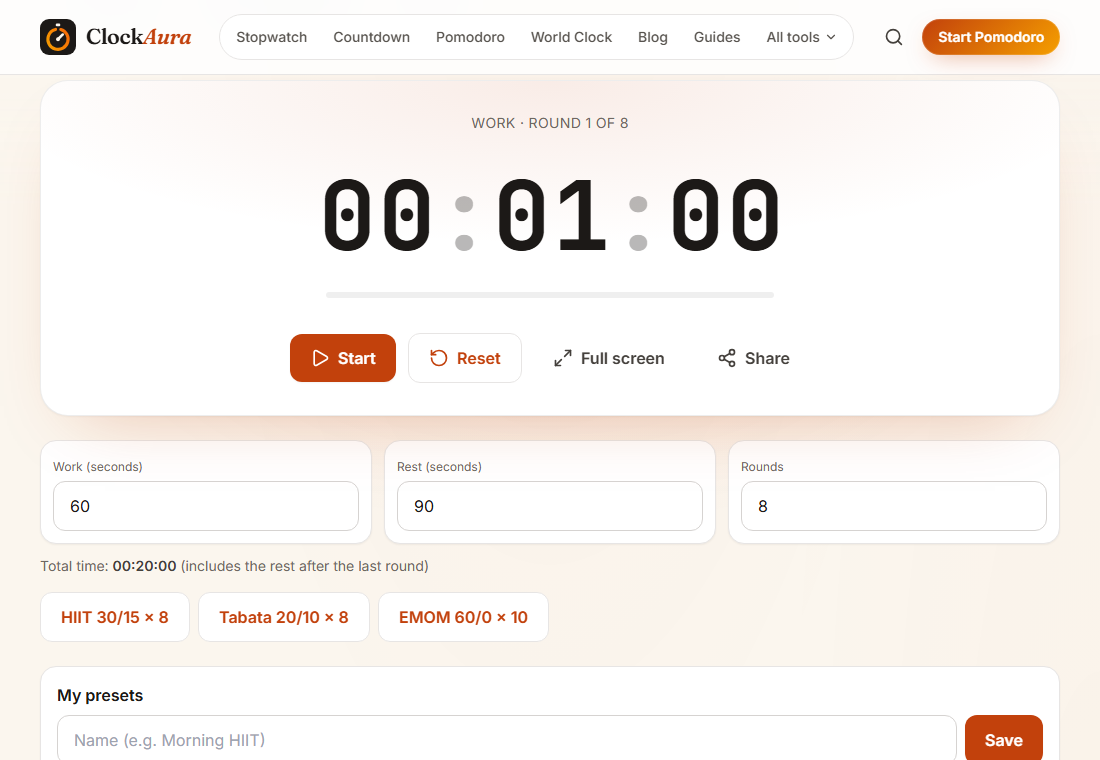
We set the timer to 60 seconds run, 90 seconds walk and 8 rounds for the screenshot above, which is Week 1 of the plan.
- Open the interval timer with Week 1 loaded.
- Do your 5-minute warm-up walk first, then press start.
- Run on the work beep, walk on the rest beep. Total time is 20 minutes.
- For later weeks, change the three numbers from the table, for example 180, 120 and 5 for Week 3.
A short safety note
This plan is general guidance for healthy adults, not medical advice. If you have a heart condition, high blood pressure, joint problems, are pregnant, or have not exercised in a long time, check with a doctor before starting. Stop and get help if you feel chest pain, dizziness, or unusual shortness of breath. Mild muscle soreness after early sessions is normal; sharp or worsening pain is not, and is a reason to rest.
FAQ
Can I do run-walk on a treadmill? Yes. Set the treadmill to a jogging speed for the run segments and a walking speed for the walks, and use the same interval timer on your phone. Some people find a treadmill easier because the surface is flat and predictable.
How far will I run in a session? It depends on your pace, and in this plan it genuinely does not matter. Track minutes, not kilometres, for these eight weeks. Distance will rise on its own as the running segments get longer.
Is walking a sign that I am not fit enough? No. Walking breaks are a deliberate part of the method. They let you run more total minutes than you could without them.
What should I do on rest days? Rest, or do something gentle like an easy walk or light stretching. Rest days are when your body adapts to the training.
Do I need a fancy watch? No. A phone with a free interval timer in a browser is all you need. Keep the screen awake or the sound on so you hear the beeps.